
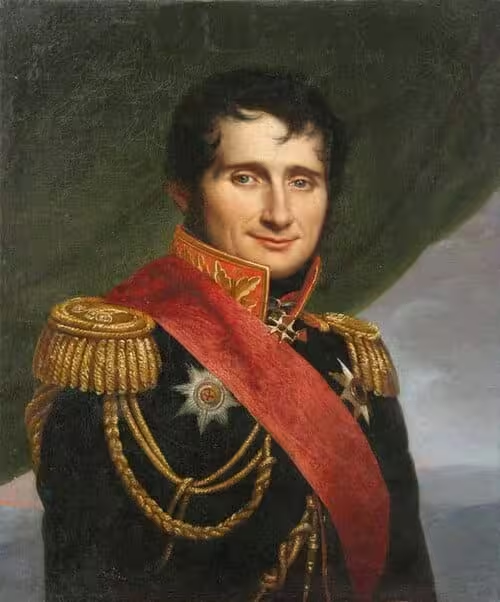
Antoine-Henri Jomini
Antoine-Henri Jomini was a Swiss-born military officer and one of the most influential strategy writers of the 19th century. Serving in the French army during the Napoleonic period and later in Russian service, he became famous for explaining war as a teachable system: decisive points, lines of operation, logistics, and the concentration of force. His writings shaped how generations of officers learned to think about campaigns.
Key facts
- Swiss-born strategist who served both France and Russia
- Known for systematizing campaign strategy: decisive points, lines of operation, bases, and communications
- Associated with Marshal Michel Ney during the Napoleonic Wars
- Authored influential works including Précis de l’Art de la Guerre (often translated as The Art of War)
- His ideas heavily influenced 19th-century military education (especially in Europe and the United States)
Early life
Jomini was born in Payerne in the Swiss canton of Vaud. Early in life he worked in business and administration before dedicating himself to the study of military history and strategy. Rather than beginning as a battlefield hero, he began as an analyst—absorbing campaigns, maps, and the mechanics of movement and supply—then pushed his way into military service through writing and staff work.
Rise to prominence
Jomini’s rise came from his ability to turn complex campaigns into clear principles. During the Napoleonic era he served on staff and gained proximity to high command, including Marshal Ney. His writings—especially his structured accounts of operations and his later synthesis of strategic “rules”—made him a recognized authority. After a contentious period within the French system, he entered Russian service, where he continued advising and writing, turning his reputation into a long career as a theorist of operational art.
Religion & philosophy
Jomini wrote within a European Christian cultural world, but his work is overwhelmingly practical and secular. His strategy focuses on organization, movement, logistics, terrain, morale, and decision—treating war as a human and institutional problem more than a theological one.
Challenges
Jomini’s career was shaped by the political and personal volatility of wartime institutions. He faced rivalry, accusations, and career friction within Napoleonic command structures, and his shift from French to Russian service made him controversial in the eyes of some contemporaries. He also faced an intellectual challenge: critics argued that war could not be reduced to neat rules, especially when chance and human will distort every plan—an objection later associated with Clausewitz.
Legacy
Jomini’s legacy is the “engineering” tradition of strategy: war as a system that can be analyzed, taught, and improved through principles. His vocabulary—decisive points, interior lines, bases, communications—helped officers think about campaigns as coherent designs rather than disconnected battles. For much of the 19th century, his approach dominated military education, and even where later thinkers rejected his rigidity, they still had to argue against his framework.
Death and succession
Jomini died in 1869 near Paris. He did not found a single school in the way Plato or Aristotle did, but his influence spread through military academies and staff colleges, where his books became standard reading. His “successors” were the generations of officers trained in the operational language he helped popularize.