
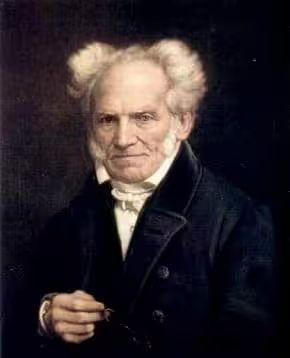
Arthur Schopenhauer
Arthur Schopenhauer was a German philosopher known for his unsentimental realism about desire, suffering, and the limits of happiness. He argued that the world is driven by a blind striving he called the Will, and that peace comes less from chasing success than from mastering desire, cultivating inner life, and seeing through vanity. His influence later reached Nietzsche, Freud, Wagner, and modern pessimistic and psychological philosophy.
Key facts
- Author of The World as Will and Representation (1818; expanded 1844)
- Wrote Aphorisms on the Wisdom of Life (1851) as practical philosophy for living
- Strongly influenced by Kant and by Indian philosophy (especially Upanishads and Buddhism)
- Known for sharp critiques of academic philosophy, especially Hegel
- Major influence on later thinkers and artists including Nietzsche, Freud, and Wagner
Early life
Schopenhauer was born in Danzig to a wealthy merchant family. His father wanted him to pursue commerce, and Schopenhauer traveled widely as a young man, absorbing different cultures and developing an early skepticism about social ambition. After his father’s death, he shifted decisively toward intellectual life, studying in Germany and becoming intensely focused on philosophy, literature, and the problem of human suffering.
Rise to prominence
Schopenhauer’s major work, The World as Will and Representation, appeared in 1818, presenting a powerful metaphysical system grounded in Kant but darker in tone: beneath appearances is the Will—endless striving that produces dissatisfaction. The book was initially ignored, and Schopenhauer spent years in frustration, including a failed attempt to compete with the popular lectures of Hegel. Over time, especially after the publication of Parerga and Paralipomena in 1851, his style and psychological clarity gained a wide readership, and his reputation rose sharply late in life.
Religion & philosophy
Schopenhauer was not conventionally religious. He rejected the optimistic providential view of the world, but he deeply admired ascetic and contemplative traditions, especially Buddhism and the Upanishads, which he saw as honest about suffering and desire. His ethics emphasizes compassion and the quiet reduction of ego rather than obedience to a divine command.
Challenges
Schopenhauer struggled with professional recognition for decades, living in the shadow of dominant academic figures like Hegel. He was also temperamentally solitary and often combative, which limited alliances. His pessimistic worldview clashed with the optimistic spirit of his age, and he spent much of his career writing for a public that wasn’t ready to hear him—until late success arrived.
Legacy
Schopenhauer helped redirect philosophy toward psychology: motives, desire, suffering, boredom, and the inner life. His writing shaped later pessimism, existential themes, and modern discussions of will, impulse, and self-deception. He also served as a major bridge between Western philosophy and Indian thought for European readers. Today he remains one of the clearest voices for practical realism: reduce unnecessary desire, protect inner wealth, and stop outsourcing your worth to status.
Death and succession
Schopenhauer died in Frankfurt in 1860 after finally achieving wide recognition. He founded no formal school, but his intellectual ‘succession’ is visible in the thinkers and artists who absorbed his ideas—especially Nietzsche’s early work, the psychological tradition influenced by Freud, and the broader modern interest in suffering, desire, and meaning.