
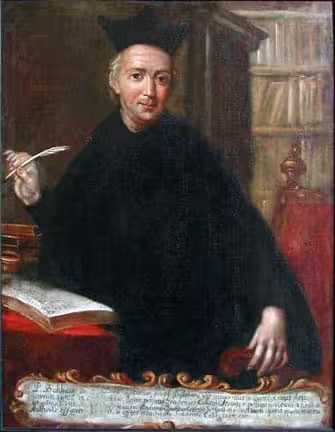
Baltasar Gracián
Baltasar Gracián was a Spanish Jesuit priest, writer, and moral philosopher whose sharp aphorisms turned social life into a craft: prudence, timing, discretion, and self-mastery. His most famous work, Oráculo manual y arte de prudencia (The Art of Worldly Wisdom), distills courtly realism into 300 maxims on how to live intelligently among ambitious, emotional, status-driven human beings.
Key facts
- Jesuit priest and major writer of Spain’s Baroque era
- Author of Oráculo manual y arte de prudencia (1647), a collection of 300 maxims
- Known for themes of prudence, discretion, timing, and reputation management
- Also wrote El Criticón, a major allegorical work of Spanish literature
- Influenced later thinkers and writers, including La Rochefoucauld and Nietzsche
Early life
Gracián was born in Belmonte in the Kingdom of Aragon. He studied in Jesuit institutions and entered the Society of Jesus as a young man, receiving rigorous training in philosophy, theology, rhetoric, and classical literature. His early formation combined religious discipline with a keen eye for human motives and social behavior.
Rise to prominence
Gracián gained recognition through works that blended moral instruction with literary brilliance. His reputation grew as his aphoristic style—dense, precise, and psychologically sharp—proved ideal for an age of courts, patronage, and political intrigue. The Art of Worldly Wisdom became his most enduring book, offering a compact manual of prudence that traveled far beyond Spain through translation and imitation.
Religion & philosophy
Gracián was a Jesuit priest, and his worldview is shaped by Christian moral seriousness and the Jesuit emphasis on discipline and prudence. Yet his writing is notably worldly in tone: he treats social reality as it is—tempting, competitive, and full of deception—while still insisting that self-mastery and moral restraint are the foundations of lasting success.
Challenges
Gracián’s greatest challenge was institutional: his publishing ambitions conflicted with Jesuit expectations of obedience and caution. Some of his later works, especially El Criticón, were published without proper permission and brought censure from his order. He faced penalties and restrictions, reflecting the tension between his independent literary voice and the constraints of religious authority.
Legacy
Gracián remains one of the greatest writers of practical wisdom. His influence shows up wherever people study strategy, reputation, and the psychology of social life. The Art of Worldly Wisdom is frequently compared to Machiavelli in its realism, but it is more personal and ethical in tone: it teaches how to navigate power without becoming reckless or noisy. His maxims have become a long-lived toolkit for discretion, timing, and intelligent self-presentation.
Death and succession
Gracián died in 1658 in Tarazona, Spain. He founded no formal school, but his work survived through constant translation and quotation, passing into the European tradition of aphoristic moralists and later into modern strategy and self-mastery literature.