
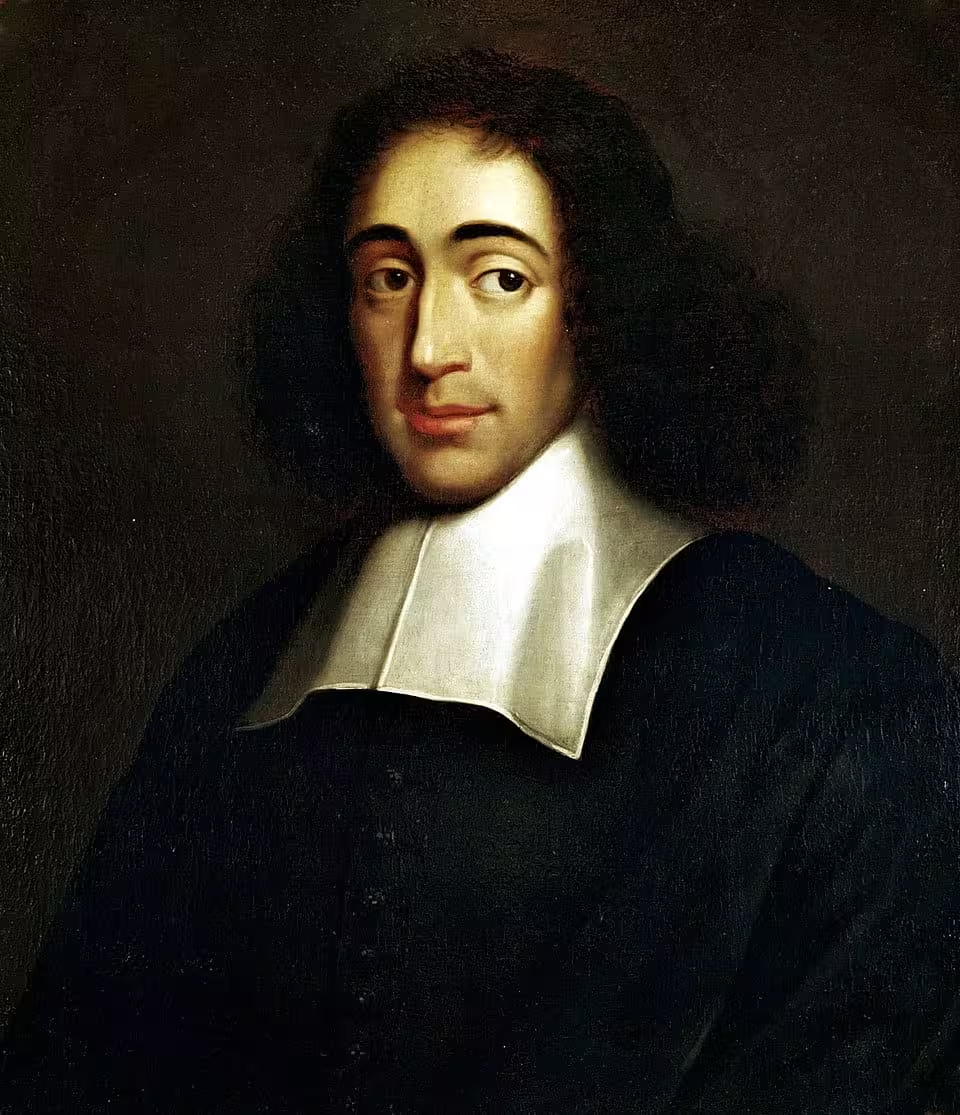
Baruch Spinoza
Baruch Spinoza was a Dutch philosopher whose work reshaped metaphysics, ethics, and the philosophy of mind. He argued that reality is one unified system—“God or Nature”—governed by necessity, and that human freedom is achieved through understanding causes rather than being driven by blind passions. His masterpiece, Ethics, presented philosophy in a geometric style of definitions and proofs and became one of the most influential books of early modern thought.
Key facts
- Author of Ethics (published posthumously in 1677)
- Developed the famous doctrine “Deus sive Natura” (“God or Nature”)
- Advanced a rigorous form of determinism and redefined freedom as understanding
- Wrote major works on religion and politics, including the Theological-Political Treatise
- Excommunicated from the Amsterdam Jewish community in 1656
Early life
Spinoza was born in Amsterdam into a Sephardic Jewish community formed by refugees from Iberian persecution. He received a strong education in Hebrew scripture, language, and traditional learning, while also absorbing the intellectual currents of the Dutch Republic. As his philosophical views diverged from communal orthodoxy, tensions grew, culminating in his excommunication while still a young man.
Rise to prominence
Spinoza lived a quiet life and avoided public controversy, supporting himself largely through lens-grinding and assistance from friends. Yet his ideas spread through manuscripts and correspondence with leading intellectuals across Europe. Theological-Political Treatise established his reputation as a radical critic of superstition and religious coercion. After his death, Ethics was published and quickly became a landmark work—admired for its precision, feared for its implications, and debated by nearly every major philosopher who followed.
Religion & philosophy
Spinoza rejected traditional personal-theistic views of God and argued for a philosophical conception: God as the single infinite substance identical with nature’s necessary order. This view led many contemporaries to accuse him of atheism, though Spinoza considered himself deeply religious in a rational sense—seeking intellectual love of God through understanding reality.
Challenges
Spinoza faced social and religious isolation after his excommunication and lived under the risk of political and theological hostility. His writings were controversial and sometimes published anonymously. He also struggled with fragile health for much of his life, likely worsened by the dust and strain of lens-grinding, while maintaining extraordinary intellectual discipline and calm.
Legacy
Spinoza became a central figure in modern philosophy, influencing Enlightenment debates about religion, freedom, and the state, and later shaping German idealism, Romanticism, and modern secular ethics. His emotional theory—understanding affects as natural events and transforming passive passions into active understanding—remains influential in moral psychology. Spinoza’s vision of freedom as clarity continues to attract readers seeking calm strength grounded in reason.
Death and succession
Spinoza died in The Hague in 1677. Soon after, friends published his major works, including Ethics. He founded no institution, but his intellectual ‘succession’ is visible in the philosophers who wrestled with him—Leibniz, Kant, Hegel, and many others—and in modern thinkers drawn to his synthesis of metaphysics, psychology, and ethical liberation.