
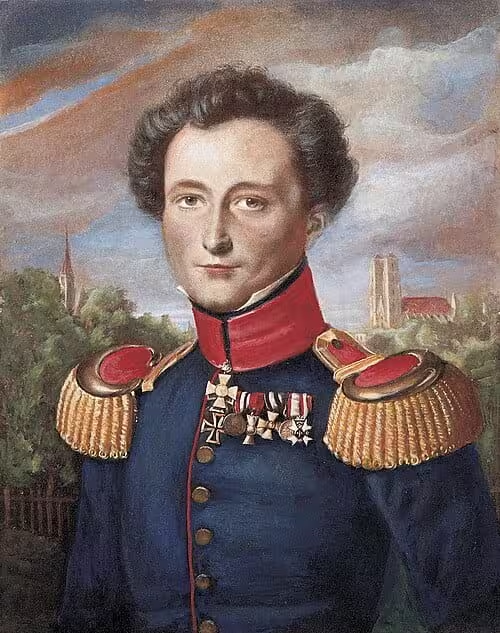
Carl von Clausewitz
Carl von Clausewitz was a Prussian soldier and military theorist whose unfinished masterpiece, On War, became the foundational modern work on strategy. Shaped by the Napoleonic Wars, he argued that war is not an isolated activity but a political instrument, dominated by uncertainty, friction, and human will. His ideas—war as the continuation of policy, fog and friction, centers of gravity—still shape strategic thinking far beyond the battlefield.
Key facts
- Prussian officer shaped by the Napoleonic Wars
- Author of On War (Vom Kriege), published posthumously in 1832
- Famous for describing war as the continuation of politics by other means
- Developed concepts like friction, fog of war, and center of gravity
- Served in the Prussian reform movement and later held senior staff roles
Early life
Clausewitz was born in Burg in Prussia and entered military service at a young age. Early exposure to war and the harsh realities of campaigning shaped his realism. He later studied at the Prussian War College in Berlin, where he came under the influence of reform-minded officers, especially Gerhard von Scharnhorst, who helped develop his analytical approach to warfare.
Rise to prominence
Clausewitz gained experience through multiple campaigns against Napoleonic France and became deeply involved in the intellectual reform of the Prussian army. His close relationship with the reform movement placed him near the center of modern staff thinking. Over time he moved into high-level positions, combining battlefield experience with theoretical reflection. His work On War grew out of this tension: trying to think clearly about conflict while knowing how quickly real war shatters tidy theory.
Religion & philosophy
Clausewitz wrote within a Christian cultural world, but his theory is secular and political. He treats war as a human and state activity shaped by passions, chance, and reason, rather than as a moral crusade guided by providence. His focus is strategic clarity: aligning violence with political purpose.
Challenges
Clausewitz lived through the collapse and humiliation of Prussia under Napoleon and the long struggle to rebuild military and political strength. His career also involved political complexity, including periods of service outside Prussia’s immediate command structures. He died during a cholera outbreak, leaving On War unfinished and vulnerable to misreading—especially by those who treat isolated quotes as slogans.
Legacy
Clausewitz transformed strategy by insisting that war belongs to politics and is shaped by uncertainty, human emotion, and imperfect information. His concepts of friction and fog of war describe why plans fail and why judgment matters more than formulas. His idea of the center of gravity provided a way to focus effort on an enemy’s true source of strength. On War remains a core text in military academies and is widely applied to business, statecraft, and any domain where conflict and uncertainty collide.
Death and succession
Clausewitz died in 1831 and his wife, Marie von Clausewitz, edited and published On War in 1832. His ideas became central to modern military education and strategic theory. While he founded no school in an institutional sense, his intellectual successors include generations of strategists and political thinkers who treat conflict as a complex system rather than a set of simple rules.