
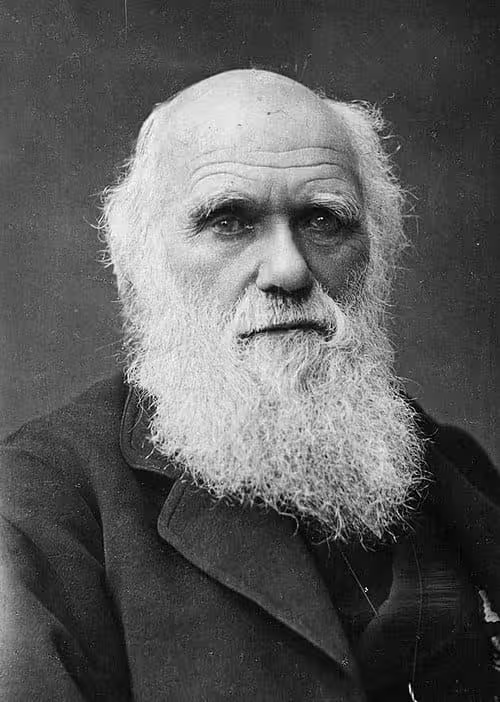
Charles Darwin
Charles Darwin was an English naturalist whose theory of evolution by natural selection transformed biology and reshaped humanity’s understanding of itself. After formative years collecting specimens and observing nature during the voyage of HMS Beagle, Darwin developed a powerful explanation for how species change over time. His later works extended these ideas to human origins, emotion, and sexual selection.
Key facts
- Voyaged on HMS Beagle (1831–1836), gathering evidence that shaped his evolutionary theory
- Published On the Origin of Species (1859)
- Published The Descent of Man (1871), applying evolution to humans and introducing sexual selection
- Developed the theory of natural selection independently alongside Alfred Russel Wallace
- Lived and worked largely at Down House, producing major scientific works despite chronic illness
Early life
Darwin was born in Shrewsbury into a well-educated family. He studied medicine briefly in Edinburgh but found it unbearable, then shifted to Cambridge with the expectation of becoming an Anglican clergyman. His true passions were natural history and collecting. Mentors at Cambridge helped secure him a place on the HMS Beagle, a journey that provided the observations—geology, fossils, species variation, and island biogeography—that later fed into his theory of evolution.
Rise to prominence
After returning from the Beagle, Darwin became a respected figure in scientific circles through his publications and extensive correspondence. Over time he developed the theory of natural selection, but delayed publication for years while gathering evidence and anticipating controversy. In 1858, a manuscript from Alfred Russel Wallace pushed him to publish jointly, and Darwin soon released On the Origin of Species (1859), which triggered major intellectual upheaval. He later expanded his work into human evolution, sexual selection, and the study of emotion.
Religion & philosophy
Darwin’s religious views changed over his lifetime. Raised in a Christian culture and initially considering clerical work, he gradually moved away from orthodox belief as his scientific conclusions and personal experiences reshaped his outlook. He is often described as ending his life as an agnostic, focusing on natural explanations rather than theological ones.
Challenges
Darwin faced intense controversy over evolution, including cultural, religious, and scientific resistance. He also suffered long-term illness (with debated causes), which limited travel and public engagement. Personal tragedy, including the death of his daughter Annie, deeply affected him. Despite these pressures, he maintained meticulous scientific discipline—testing objections, collecting evidence, and revising his work over decades.
Legacy
Darwin’s legacy is foundational to modern biology. Natural selection remains a core mechanism of evolution, and his approach—patient evidence-gathering, comparative reasoning, and openness to revision—became a model of scientific inquiry. His ideas reshaped not only biology but also psychology, anthropology, and debates about human nature. Darwin’s work continues to influence how humanity understands life, origins, and the deep continuity between humans and other animals.
Death and succession
Darwin died in 1882 and was buried in Westminster Abbey, a sign of his national and scientific significance. His intellectual successors include evolutionary biologists, geneticists, and scientists who integrated Darwin’s insights with modern genetics and ecology, forming the modern synthesis of evolutionary theory.