
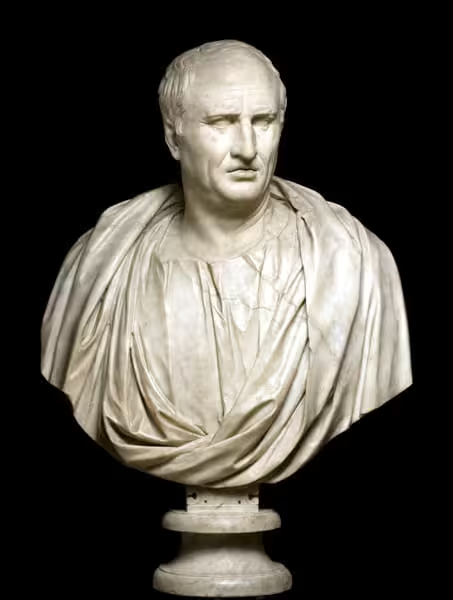
Marcus Tullius Cicero
Marcus Tullius Cicero was a Roman statesman, lawyer, and philosopher whose speeches and writings shaped Latin prose and preserved much of Greek moral and political philosophy for the West. Living through the Republic’s collapse, he defended constitutional order, the rule of law, and civic duty. His De Officiis (On Duties), written in the final year of his life, became one of the most influential guides to ethics and public responsibility in Western history.
Key facts
- Rome’s greatest orator and one of its most influential prose stylists
- Served as consul in 63 BCE and confronted the Catiline conspiracy
- Major defender of republican institutions during Rome’s political collapse
- Author of De Officiis (On Duties), written in 44 BCE as moral guidance for public life
- His letters and speeches are key primary sources for the end of the Roman Republic
Early life
Cicero was born in Arpinum to an affluent equestrian family outside Rome’s old aristocracy. He rose through talent: intense study of rhetoric, law, and philosophy, and a disciplined commitment to public speaking. Moving to Rome, he trained under leading teachers and built a legal career, gaining reputation through courtroom advocacy and political ambition.
Rise to prominence
Cicero advanced through the Roman cursus honorum largely on merit and rhetorical skill, culminating in his election as consul in 63 BCE. His handling of the Catiline conspiracy made him both famous and controversial. As Rome’s politics turned increasingly violent and dominated by powerful generals, Cicero attempted to defend republican legality through speeches, alliances, and writing. After Julius Caesar’s assassination, he re-entered politics and delivered the Philippics—attacks on Mark Antony—staking his life on the Republic’s survival.
Religion & philosophy
Cicero respected traditional Roman religion as a civic institution but approached theology philosophically. In works like On the Nature of the Gods, he explored arguments about divine order with skepticism and intellectual balance. His ethical writing draws heavily on Stoic and Academic traditions, emphasizing natural law, duty, and justice rather than sectarian piety.
Challenges
Cicero’s career was battered by exile, shifting alliances, and the brutal reality of late-republic power politics. He struggled to preserve constitutional norms in a world moving toward dictatorship. His decision to oppose Mark Antony after Caesar’s death ultimately proved fatal, as the Second Triumvirate targeted him during the proscriptions.
Legacy
Cicero became one of the central transmitters of classical philosophy to the Latin West. His ethical and political writings shaped medieval and Renaissance education, influencing statesmen, theologians, and humanists. On Duties in particular served as a standard text on integrity, justice, and the tension between honor and advantage. His letters remain among the best windows into Roman political life, and his vision of law-governed public duty continues to define what “republican virtue” means.
Death and succession
Cicero was executed in 43 BCE during the proscriptions of the Second Triumvirate. His death symbolized the Republic’s end and the triumph of force over constitutional speech. Though he founded no school, his intellectual successors were the generations educated on his prose and moral arguments—Renaissance humanists, Enlightenment thinkers, and modern defenders of civic law and republican government.