
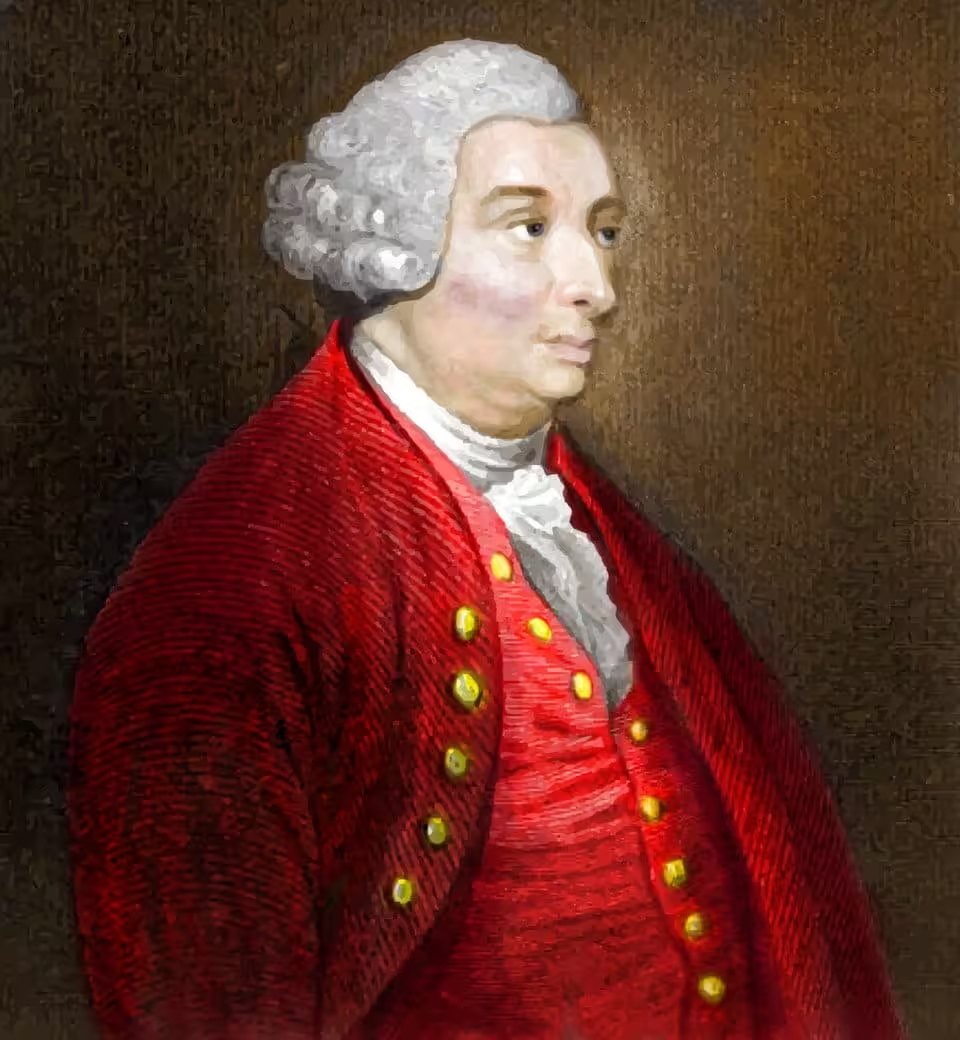
David Hume
David Hume was a Scottish philosopher and historian whose skeptical, empirical approach reshaped modern thought about knowledge, human nature, religion, and politics. He argued that many beliefs rest on habit and sentiment rather than pure reason, and his essays offered a calm, realistic account of how governments actually hold together—through opinion, institutions, and managed faction rather than moral fantasy.
Key facts
- Major figure of the Scottish Enlightenment
- Author of A Treatise of Human Nature (1739–1740)
- Published Essays, Moral and Political (1741–1742)
- Wrote influential works on religion and epistemology, including Enquiries
- Close friend of Adam Smith and a major historian of England
Early life
Hume was born in Edinburgh and raised in a modest landed family. As a young man he immersed himself in reading and philosophy with unusual intensity, aiming to build a “science of human nature.” He briefly attempted a commercial career but abandoned it, choosing the life of study. He wrote the early version of his philosophy in his twenties, largely in isolation, driven by the belief that understanding the human mind was the key to understanding everything else.
Rise to prominence
Hume’s early masterpiece, A Treatise of Human Nature, initially failed to gain the recognition he hoped for, leading him to rewrite and refine his ideas in more accessible forms. His Essays brought him wider public attention, combining philosophical realism with political and economic insight. Over time he became one of Britain’s best-known intellectuals—working as a librarian, diplomat, and public servant—while also writing a major multi-volume History of England that made him famous in his own lifetime.
Religion & philosophy
Hume is famous for his skeptical critique of religious certainty. He challenged arguments for miracles and questioned whether human reason can prove theological claims. His writing treats religion as a powerful social phenomenon—capable of moral seriousness but also prone to superstition and fanaticism—while maintaining a cautious philosophical distance from dogma.
Challenges
Hume faced significant social and institutional resistance, especially because his religious skepticism was viewed as dangerous. This contributed to failures in obtaining academic posts. He also endured early disappointment when his Treatise was not received as he expected, forcing him to develop a more persuasive public style and to rebuild his reputation through essays, revised works, and historical writing.
Legacy
Hume influenced nearly every major tradition in modern philosophy, including empiricism, skepticism, utilitarianism, and the philosophy of science. His work on causation, habit, and belief remains central in epistemology. Politically, his essays helped shape modern realism about institutions: government rests on opinion and incentives, and stable liberty requires moderation and structural restraint. Kant famously credited Hume with awakening him from “dogmatic slumber,” highlighting Hume’s lasting disruptive power.
Death and succession
Hume died in Edinburgh in 1776. He left no school in an institutional sense, but his successors include Adam Smith and the broader Scottish Enlightenment tradition, as well as later philosophers who built modern theories of knowledge, science, and politics in response to his skeptical challenges.