
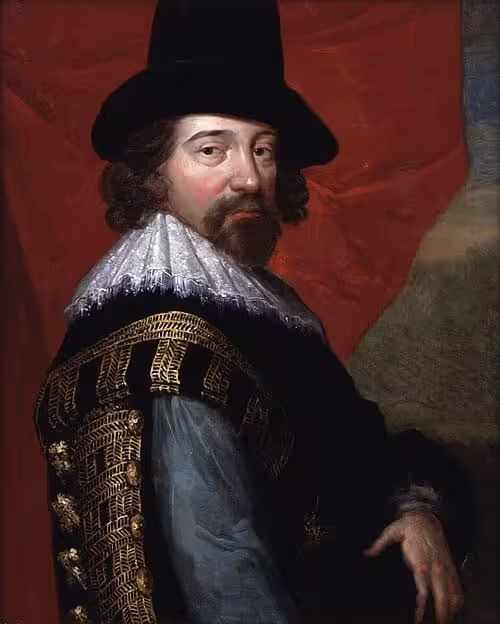
Francis Bacon
Francis Bacon was an English philosopher and statesman who argued that knowledge should be built through disciplined observation and experiment rather than inherited authority and verbal debate. He helped shape the modern scientific attitude by exposing the mind’s habitual errors and proposing a new method of inquiry—induction guided by systematic evidence. His Novum Organum (1620) became a landmark call for intellectual reform and practical knowledge.
Key facts
- Major architect of early modern empiricism and the reform of scientific method
- Author of Novum Organum (1620), proposing disciplined induction and experiment
- Introduced the famous “Idols” (Tribe, Cave, Marketplace, Theater) as a taxonomy of human bias
- Served as Lord Chancellor of England before a public fall from office
- Influenced the development of scientific institutions and the ethos of experimental inquiry
Early life
Bacon was born in London into a politically connected family and was educated at Cambridge. He entered public life early and pursued a legal and political career alongside philosophical work. From a young age he grew dissatisfied with scholastic learning, believing it produced argument without discovery. This dissatisfaction became the seed of his lifelong project: to rebuild knowledge on a more reliable foundation.
Rise to prominence
Bacon rose through English political life, serving in Parliament and eventually becoming Attorney General, Lord Keeper, and Lord Chancellor under James I. In parallel, he developed his philosophical program for reforming knowledge. Novum Organum (1620) laid out his method and his critique of intellectual tradition, while his broader project—the Great Instauration—imagined a cultural transformation where systematic inquiry would produce new arts, sciences, and practical power over nature.
Religion & philosophy
Bacon wrote within a Christian culture and did not present himself as a religious radical. He tended to separate theology from natural philosophy: faith concerns salvation, while science concerns the investigation of nature through experience. His work treats the study of nature as legitimate and even noble, provided it remains humble and disciplined rather than arrogant speculation.
Challenges
Bacon’s career ended in scandal: he was charged with corruption related to gifts received as Lord Chancellor, leading to conviction, fines, and political ruin. Although the historical interpretation of this episode is complex, the fall forced him to focus more fully on writing and intellectual legacy. He also faced the challenge of persuading a culture trained in authority and tradition to adopt a new, slower, more evidence-driven method.
Legacy
Bacon became a symbol of the experimental spirit and the idea that method matters more than brilliance. His “Idols” anticipated modern discussions of bias and self-deception, and his insistence on structured evidence helped shape later scientific practice and institutional science. Even where later philosophers criticized aspects of his induction, Bacon’s central contribution remained: knowledge should be built in public, corrected by evidence, and aimed at genuine discovery rather than rhetorical victory.
Death and succession
Bacon died in 1626 after an illness contracted during an experiment involving cold and preservation (according to the traditional story). He founded no school, but his intellectual successors were the builders of modern science and scientific institutions—thinkers who treated experiment, observation, and replicable method as the path to reliable knowledge.