
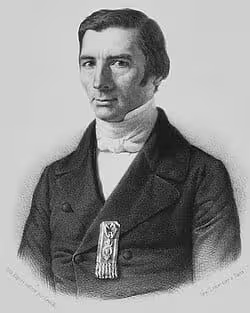
Frédéric Bastiat
Frédéric Bastiat was a French economist, writer, and legislator known for sharp, accessible arguments for free exchange, limited government, and the moral limits of law. Writing during revolutionary upheaval in France, he attacked protectionism, privilege, and what he called “legal plunder”—the use of state power to take from some and give to others under the banner of justice. His essays and pamphlets remain classics of political economy and institutional critique.
Key facts
- French political economist and legislator during the upheavals of 1848–1850
- Famous for satirical economic essays that made complex ideas readable
- Author of The Law (La Loi, 1850) and The Petition of the Candlemakers
- Critic of protectionism, monopoly privileges, and state capture by interest groups
- Associated with the “seen and unseen” principle in economic reasoning
Early life
Bastiat was born in Bayonne and raised in southwestern France. Orphaned relatively young, he inherited property and later managed a family estate in Mugron. Much of his early intellectual development was self-directed: he read widely in economics, philosophy, and political thought, gradually forming a strong interest in how laws and incentives shape society. His experience as a local notable gave him a practical view of administration, taxes, and everyday economic life.
Rise to prominence
Bastiat became widely known through economic journalism and pamphlets that defended free trade and exposed the logic of protectionism. During the 1840s he joined and led free-trade efforts in France, and after the 1848 Revolution he entered politics, serving in the National Assembly. His writing combined moral clarity with humor and precision, allowing him to reach audiences far beyond academic economics. In his final years he produced his most famous works, including The Law, while battling serious illness.
Religion & philosophy
Bastiat wrote within a French Catholic culture, but his public arguments are primarily economic and moral rather than theological. He grounds political legitimacy in natural rights—life, liberty, and property—and treats justice as the restraint of force. His work generally appeals to reason and moral intuition rather than sectarian doctrine.
Challenges
Bastiat worked in an era of revolution, ideological struggle, and intense conflict over property, labor, and the role of the state. He faced strong opposition from protected industries and political factions that benefited from tariffs and state privileges. He also struggled with failing health (tuberculosis) during the period of his greatest productivity, writing under physical decline while trying to influence policy before it was too late.
Legacy
Bastiat remains one of the most influential popularizers of economic reasoning. His “seen and unseen” lens trained generations to look beyond immediate benefits to long-term effects and hidden costs. His critique of “legal plunder” anticipated later public-choice insights about how interest groups capture policy. Whether or not readers agree with all of his conclusions, Bastiat’s gift is clarity: he teaches how to think about incentives, trade-offs, and the moral boundary between protection and coercion.
Death and succession
Bastiat died in Rome in 1850. He founded no school, but his intellectual successors include later classical liberal economists and writers who continued to emphasize free trade, limited government, and institutional skepticism. His work lives on through constant quotation and the continued relevance of his core diagnostic: ask what policies incentivize, and who quietly benefits from them.