
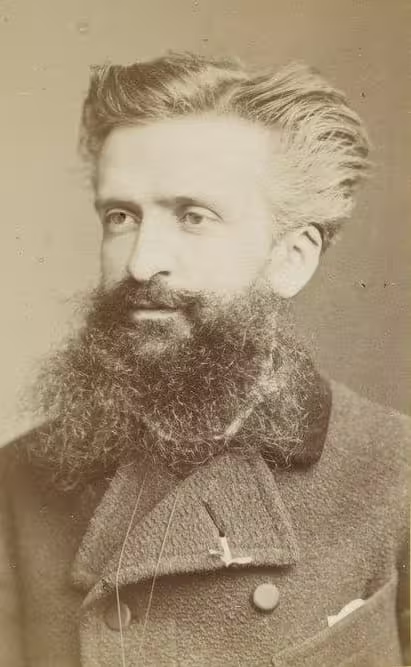
Gustave Le Bon
Gustave Le Bon was a French physician, writer, and early social psychologist best known for his influential study of mass behavior. In The Crowd (1895), he argued that individuals in groups can become more impulsive, suggestible, and emotionally driven, and he explored how leaders, symbols, and repetition shape collective belief. His ideas strongly influenced later thinking on propaganda, political movements, and public opinion—both for understanding crowds and for manipulating them.
Key facts
- Author of The Crowd: A Study of the Popular Mind (1895)
- Early theorist of crowd psychology: contagion, suggestion, anonymity, and group emotion
- Influenced 20th-century thinking on propaganda, political movements, and mass persuasion
- Wrote widely on psychology, sociology, and civilization theory
- His work became both influential and controversial for how it was later used
Early life
Le Bon was born in Nogent-le-Rotrou in France and trained in medicine. He traveled widely and developed an interest in how cultures, beliefs, and institutions shape human behavior. His early work ranged across anthropology, psychology, and social theory, reflecting a restless attempt to explain collective life rather than focusing on a single academic discipline.
Rise to prominence
Le Bon’s reputation rose sharply with the publication of The Crowd in 1895. The book arrived at a moment of political volatility in Europe—mass parties, street politics, and rapid social change—and it offered an arresting framework for why crowds behave differently from individuals. His writing style was direct and memorable, and his themes—suggestibility, symbolism, emotional contagion—made the work attractive not only to scholars but also to political operators and propagandists.
Religion & philosophy
Le Bon’s work is largely secular and psychological. Rather than focusing on theology, he treats religion as a powerful social force that shapes collective imagination, loyalty, and moral energy. He is especially interested in how belief systems function through symbols, myths, and emotional unity within groups.
Challenges
Le Bon faced the intellectual challenge of writing about society in an era when psychology and sociology were still emerging as disciplines. He also became controversial: critics accused him of overgeneralization and of portraying crowds as irrational by nature, while supporters argued he captured real patterns of mass behavior. His influence became ethically complicated as later movements used his insights for manipulation and authoritarian propaganda.
Legacy
Le Bon helped define the vocabulary of crowd psychology and left a lasting imprint on political and social thought. Many later theories of propaganda, mass persuasion, and group behavior echo his themes—even when they reject his pessimism. Today The Crowd remains useful as a warning lens: it teaches how anonymity, emotion, repetition, and symbols can override individual judgment and turn public life into an arena of contagion rather than reason.
Death and succession
Le Bon died in 1931. He founded no school, but his intellectual successors include later social psychologists, theorists of mass communication, and analysts of propaganda and public opinion. His legacy persists wherever people study how groups think—and how persuasion can hijack collective emotion.