
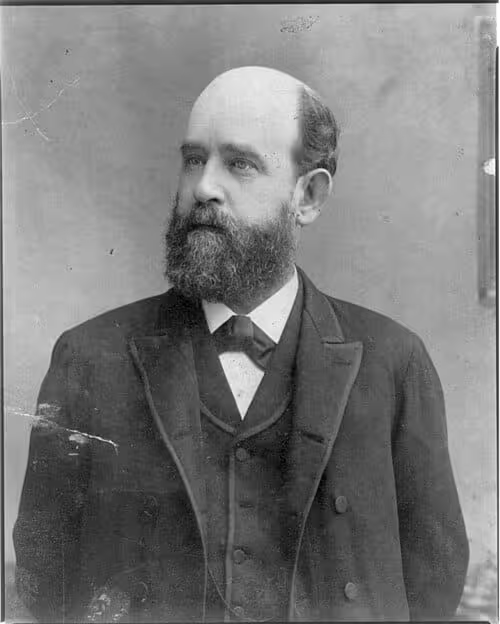
Henry George
Henry George was an American journalist and political economist who became famous for a single burning question: why does poverty persist—and often deepen—alongside rapid economic progress? In Progress and Poverty (1879), he argued that rising land values and economic rent allow owners of scarce locations to capture the gains of development. His proposed remedy, a land value tax (“single tax”), made him one of the most influential social reformers of the late 19th century.
Key facts
- Author of Progress and Poverty (1879), one of the most influential economic books of its era
- Central idea: rising land rent can capture the gains of progress, sustaining poverty amid growth
- Advocated a land value tax (often called the “single tax”) to replace or reduce other taxes
- Worked as a journalist and editor, shaping public debate beyond academia
- Ran for Mayor of New York City and became a major public figure in reform politics
Early life
George was born in Philadelphia and left formal schooling early. He went to sea as a teenager and later settled in California, working in printing and journalism. Living close to boomtown growth and hard urban poverty helped form his central question. He watched cities expand, wealth accumulate, and yet many workers remain trapped in insecurity—an observation that pushed him toward political economy as a moral and practical investigation.
Rise to prominence
George rose to international prominence with the publication of Progress and Poverty in 1879. The book’s mix of moral urgency and economic argument made it widely read across the English-speaking world. He became a leading voice of reform, lecturing internationally and engaging in political debate about property, taxation, labor, and inequality. His ability to write clearly for general audiences turned him into a public intellectual rather than a purely academic economist.
Religion & philosophy
George wrote in a culture shaped by Protestant moral seriousness, and his work often carries a strong ethical tone about justice and human dignity. While not primarily theological, his arguments appeal to moral intuition: society should not allow unearned privilege over natural opportunities to trap others in poverty. His reform vision treats economic arrangements as matters of justice, not only efficiency.
Challenges
George faced intense opposition from entrenched property interests and from critics who viewed his land-focused diagnosis as too simple or too radical. He also lived through the volatility of boom-bust economies and political factionalism, and his move from writer to political candidate exposed him to hard political combat. Despite popularity, he struggled to convert his ideas into policy at scale during his lifetime.
Legacy
Henry George helped reshape debates about inequality, land, housing costs, and the moral legitimacy of rent. The “Georgist” tradition influenced later urban planning, tax reform debates, and economic thinking about land as a distinct factor of production. Even where his single-tax program was not adopted fully, the core diagnostic remains powerful: when scarce locations absorb society’s progress through rising rents, growth can coexist with persistent poverty and instability.
Death and succession
George died in 1897 in New York City, shortly after campaigning again for mayor. His ideas lived on through Georgist organizations, reform movements, and later economists and planners who continued to argue for land value taxation and to analyze how property and rent shape social outcomes.