
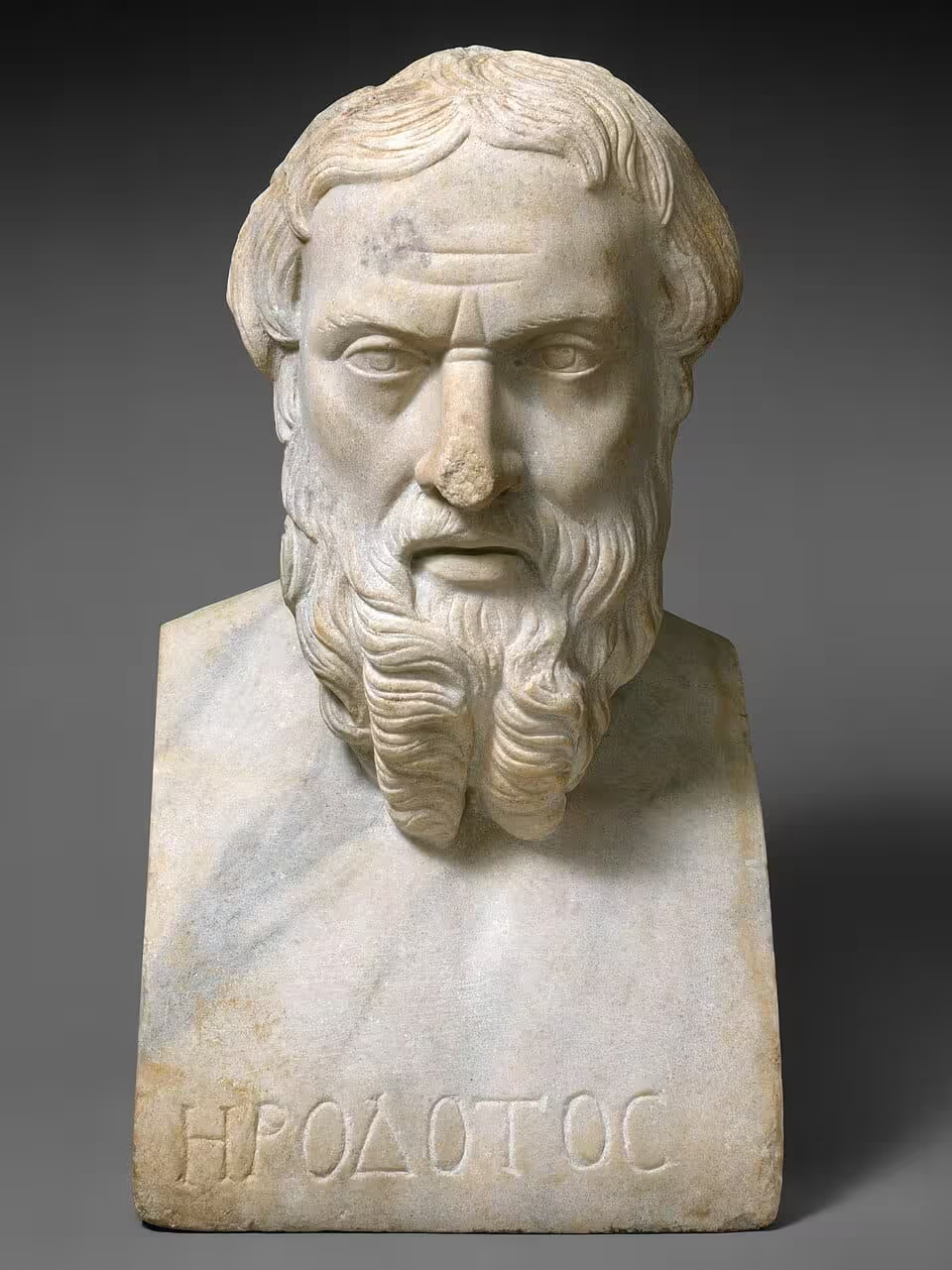
Herodotus
Herodotus was an ancient Greek historian often called the “Father of History.” His Histories is a vast inquiry into the rise of the Persian Empire and the Greco-Persian Wars, written to preserve memory and investigate causes. Blending travel writing, ethnography, and political storytelling, he built a new kind of literature: history as investigation into power, culture, and human behavior.
Key facts
- Author of Histories, the founding classic of Western historiography
- Known as the “Father of History” for treating the past as inquiry (historiē)
- Combined war narrative with ethnography, geography, and cross-cultural description
- Central subject: the Greco-Persian Wars and the rise of Persian power
- Preserved countless stories, speeches, and traditions that would otherwise be lost
Early life
Herodotus was born in Halicarnassus, a Greek city under Persian influence in Asia Minor. His early life unfolded in a border-world of cultures and empires, likely shaping his curiosity about customs and political power. He traveled widely across the Mediterranean and Near East—Egypt, the Levant, the Black Sea region, and Greek city-states—collecting stories, observations, and local accounts that became the raw material of his Histories.
Rise to prominence
Herodotus gained recognition through public recitations of his work and through his ability to turn sprawling historical material into a coherent inquiry. His Histories does more than record battles: it explains how events unfold from pride, fear, revenge, misunderstanding, and ambition. By presenting multiple versions of disputed events and signaling uncertainty, he offered a new model of historical writing—one that aimed at explanation rather than mere commemoration.
Religion & philosophy
Herodotus wrote within the polytheistic religious world of ancient Greece, and his narrative includes oracles, omens, and divine themes as forces that shaped how people interpreted events. Yet he often treats these elements with a historian’s distance, recording what communities believed while also emphasizing human motives and political causes. His work stands at the boundary between mythic interpretation and historical explanation.
Challenges
Herodotus faced the challenge of writing history in a world where evidence was largely oral, partisan, and geographically dispersed. He had to navigate rumor, propaganda, regional pride, and conflicting testimonies. The scale of his ambition—linking cultures and events across continents—required synthesizing imperfect sources into a readable and meaningful account without pretending to certainty he did not possess.
Legacy
Herodotus set the template for history as a human inquiry: preserve memory, compare accounts, seek causes, and treat cultural difference as part of explanation. His work influenced later historians—especially Thucydides—and remains essential for understanding ancient Greece, Persia, and the wider Mediterranean world. Beyond facts, his legacy is a method: ask not only what happened, but why people believed what they believed, and how belief becomes action.
Death and succession
Herodotus likely died in the late 5th century BCE. He founded no school, but his successors were the later historians who refined the craft of inquiry. Thucydides tightened the method into severe political realism; later writers inherited Herodotus’s model of history as explanation, travel, and human psychology combined.