
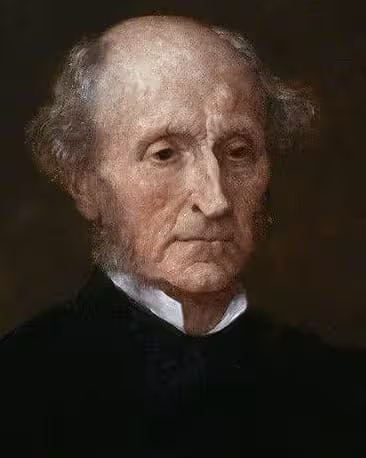
John Stuart Mill
John Stuart Mill was an English philosopher, economist, and public intellectual who became the most influential defender of liberal freedom in the 19th century. He argued that the greatest threat to liberty in modern societies is not only government tyranny but the “tyranny of the majority”—social pressure that crushes individuality, dissent, and experimentation in living. In On Liberty, he formulated the harm principle: power is only justified over an individual to prevent harm to others. Mill also refined utilitarianism into a richer moral theory that values higher forms of human flourishing, and he became a major voice for equality, especially in The Subjection of Women. His work remains central to debates about free speech, democracy, education, and the boundaries of law and morality.
Key facts
- Leading 19th-century liberal thinker and major figure in utilitarian ethics
- Author of On Liberty, Utilitarianism, and The Subjection of Women
- Formulated the harm principle: coercion is justified only to prevent harm to others
- Defended freedom of speech, individuality, and “experiments in living” against social conformity
- Advocated women’s equality and political reform; served as a Member of Parliament (1865–1868)
Early life
Mill was born in London and educated under an intense, highly structured program designed by his father, James Mill, with input from Jeremy Bentham’s circle. He learned Greek and Latin early, studied logic and political economy, and was trained to become a rational reformer. The pressure produced a famous mental crisis in his early twenties, forcing him to confront the limits of purely analytical education. He recovered by turning toward poetry, emotion, and a broader conception of human happiness—changes that profoundly shaped his mature philosophy.
Rise to prominence
Mill’s intellectual stature grew through his essays, books, and public engagement, as well as his long career at the British East India Company. He became a central voice in Victorian debates about liberty, democracy, and social progress. Mill combined philosophical argument with practical reformist energy: he wrote not only to interpret society, but to improve it—especially by protecting individuality, expanding political participation, and challenging entrenched inequalities.
Religion & philosophy
Mill was raised without traditional religious belief and remained broadly secular, though he took moral seriousness and “religion-like” ethical commitment seriously. He was critical of dogma and coercive moral authority, but he admired ethical ideals that elevate human character. For Mill, moral progress depended on open discussion, education, and social institutions that cultivate autonomy and empathy rather than obedience to unquestioned tradition.
Challenges
Mill’s liberalism faced a world of rapid industrialization, deep class inequality, and expanding mass politics. He had to defend individual freedom while also acknowledging the need for social reforms and economic protections. He also faced personal and intellectual controversy, especially around his relationship with Harriet Taylor, whose influence he credited as central to his thought. Philosophically, he confronted the challenge of strengthening utilitarianism against the accusation that it reduces human life to crude pleasure, responding with a more complex view of quality, dignity, and self-development.
Legacy
Mill remains one of the key architects of modern liberal democratic culture: free speech, pluralism, toleration, and limits on coercion. His arguments are still foundational in legal and political debates about censorship, personal autonomy, and the role of the state. In ethics, he reshaped utilitarianism into a theory concerned not only with pleasure but with higher capacities and long-term flourishing. In social thought, his defense of women’s equality helped set an intellectual standard for modern feminism and egalitarian reform.
Death and succession
Mill died in 1873 in Avignon, France, where he lived near Harriet Taylor Mill’s grave. He founded no school in the strict sense, but his successors include liberal theorists, free speech advocates, and reformers who built institutions around rights and public reason. His work continues to “succeed” wherever societies try to protect individuality and dissent while still pursuing collective welfare.