
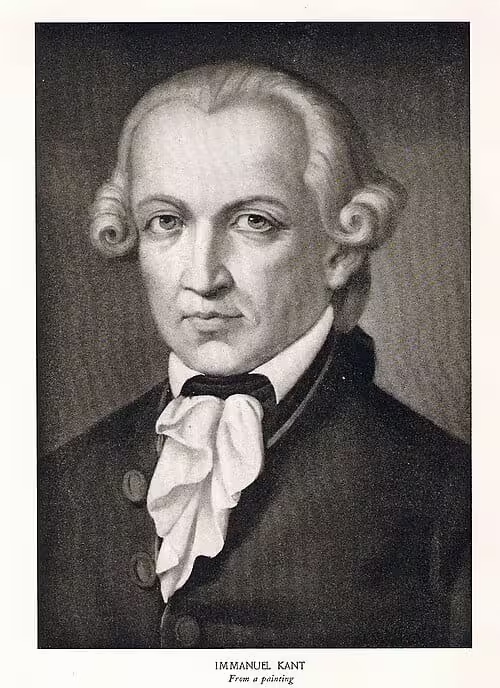
Immanuel Kant
Immanuel Kant was a German Enlightenment philosopher whose work reshaped modern thought by asking a single revolutionary question: what are the limits and powers of human reason? In the Critique of Pure Reason, he argued that the mind actively structures experience, making knowledge possible while also setting boundaries on what we can legitimately claim. In ethics, he grounded morality in rational duty—most famously through the categorical imperative—creating a moral philosophy built on universal principles rather than outcomes or custom. Kant’s system became a turning point: after him, philosophy had to reckon with the conditions of knowledge, the autonomy of ethics, and the dignity of persons.
Key facts
- Central figure of the European Enlightenment and one of the most influential philosophers in history
- Author of the three Critiques: Pure Reason, Practical Reason, and Judgment
- Developed “transcendental idealism”: we know phenomena as structured by the mind, not “things-in-themselves” directly
- Founded modern deontological ethics and the categorical imperative (duty-based morality)
- Argued for human dignity and autonomy: persons must be treated as ends, not merely as means
Early life
Kant was born and lived almost his entire life in Königsberg, a Prussian university town. Raised in a strict Pietist Lutheran environment, he developed an early respect for discipline, conscience, and moral seriousness. He studied at the University of Königsberg, where he absorbed mathematics, physics, and philosophy, including the rationalist tradition (especially Leibniz and Wolff) and the emerging prestige of Newtonian science. His early career included years as a private tutor before returning to academia and eventually becoming a professor.
Rise to prominence
Kant’s philosophical breakthrough came later in life, after years of teaching and writing. He credited David Hume with “awakening” him from a dogmatic slumber by forcing him to confront how causation and necessity could be justified. Kant’s response was a new approach—transcendental philosophy—asking not what the world is in itself, but what must be true about the mind for experience and science to be possible at all. The Critique of Pure Reason (1781; revised 1787) established him as a major thinker and set the agenda for much of modern philosophy.
Religion & philosophy
Kant remained culturally and personally shaped by Protestant Christianity, but he insisted that religion must be evaluated through reason and morality. He argued that genuine religion is not superstition or ritual control, but the moral transformation of the person—religion “within the bounds of reason alone.” He treated traditional metaphysical proofs of God as philosophically unsound, yet defended a form of moral faith: ideas like God and immortality function as practical postulates that support the moral life rather than as objects of theoretical knowledge.
Challenges
Kant faced the intellectual challenge of reconciling two powerful forces: empiricism (knowledge from experience) and rationalism (knowledge from reason). He also had to answer skepticism about causation, freedom, and metaphysics without collapsing into either dogmatism or nihilism. Late in life, his writings on religion brought political pressure and censorship from Prussian authorities, highlighting the tension between Enlightenment freedom of thought and state control. Philosophically, his system also had to hold together multiple domains—science, ethics, aesthetics, and politics—without letting one reduce the others.
Legacy
Kant transformed epistemology by making the “conditions of possible experience” the central problem of philosophy, and he transformed ethics by grounding morality in autonomy, universality, and respect for persons. His influence shaped German Idealism (Fichte, Schelling, Hegel), modern theories of rights and political legitimacy, and later movements from phenomenology to analytic philosophy. In moral and political thought, his insistence on human dignity, universal law, and non-instrumental respect remains foundational to modern ideas of rights, justice, and liberal constitutionalism.
Death and succession
Kant died in Königsberg in 1804 after a long period of declining health. He founded no formal school, but his successors were immediate and immense: German Idealists extended and contested his project, while later Neo-Kantians revived his method in response to modern science and skepticism. Across centuries, Kant’s enduring “succession” is the continuing demand that philosophy justify knowledge, defend moral autonomy, and clarify what reason can—and cannot—claim.