
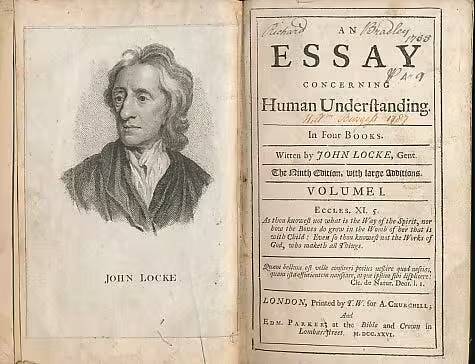
John Locke
John Locke was an English philosopher and physician whose ideas laid much of the intellectual groundwork for liberalism and modern constitutional government. He argued that legitimate political authority arises from the consent of the governed, that individuals possess natural rights (life, liberty, and property), and that government exists to protect those rights—losing legitimacy when it violates them. In epistemology, he became a founding figure of modern empiricism, claiming that the mind begins as a “blank slate” and that knowledge is built from experience and reflection. Locke’s work shaped political revolutions, modern rights discourse, and the philosophical vocabulary of freedom, toleration, and limited government.
Key facts
- Key architect of modern liberal political philosophy and natural rights theory
- Author of Two Treatises of Government and An Essay Concerning Human Understanding
- Argued that legitimate government rests on consent and must protect natural rights
- Defended religious toleration and limits on state power over conscience
- Major figure in empiricism: knowledge arises from experience rather than innate ideas
Early life
Locke was born in Somerset, England, during the political turbulence leading into the English Civil War. Educated at Westminster School and Christ Church, Oxford, he studied classics, philosophy, and medicine. Dissatisfied with purely scholastic approaches, he turned toward the new science and experimental methods shaping early modern thought. His medical training and scientific interests deeply influenced his philosophical temperament: careful observation, skepticism toward grand speculative systems, and attention to how knowledge is actually formed.
Rise to prominence
Locke’s rise was tied to both intellectual and political life. He became associated with influential political circles and developed a theory of government suited to a post–civil-war England: authority is not divine right but a trust granted by the people. His major political writings argued that when rulers violate the purpose of government—protecting rights and the common good—citizens have a right to resist and replace them. In philosophy, his Essay established him as a central thinker by offering a comprehensive account of how the mind acquires ideas, forms concepts, and justifies knowledge.
Religion & philosophy
Locke’s religious thought centered on reason, toleration, and the limits of coercion. He argued that genuine belief cannot be forced and that the state should not command conscience. His writings defended broad toleration among Christian groups and insisted that civil government’s proper domain is worldly peace and rights, not salvation. He also sought a rational account of Christianity that emphasized moral practice and sincere faith over sectarian power.
Challenges
Locke worked in an era of intense political surveillance, censorship, and factional struggle. His associations and ideas placed him at risk, and he spent time in exile in the Netherlands. Philosophically, he faced the challenge of grounding knowledge without appealing to innate ideas, while also avoiding skepticism. Politically, he had to defend limited government and popular consent without endorsing chaos—arguing for a right of resistance that remains constrained by the purpose of preserving rights and civil order.
Legacy
Locke’s influence on political theory is immense: natural rights, consent, limited government, and the legitimacy of resistance became pillars of modern constitutionalism. His ideas strongly shaped later liberal thought and the language of rights used in revolutionary contexts, especially in the English-speaking world. In philosophy, his empiricism helped set the agenda for later thinkers such as Berkeley and Hume and remains foundational for modern debates about mind, knowledge, education, and political legitimacy.
Death and succession
Locke died in 1704 in England after years of ill health. His successors included Enlightenment philosophers who expanded empiricism and liberal political theory, as well as constitutional thinkers who built institutions around rights, representation, and legal restraint. Across centuries, Locke’s “succession” is visible wherever governments justify themselves as trustees of rights rather than masters of subjects.