
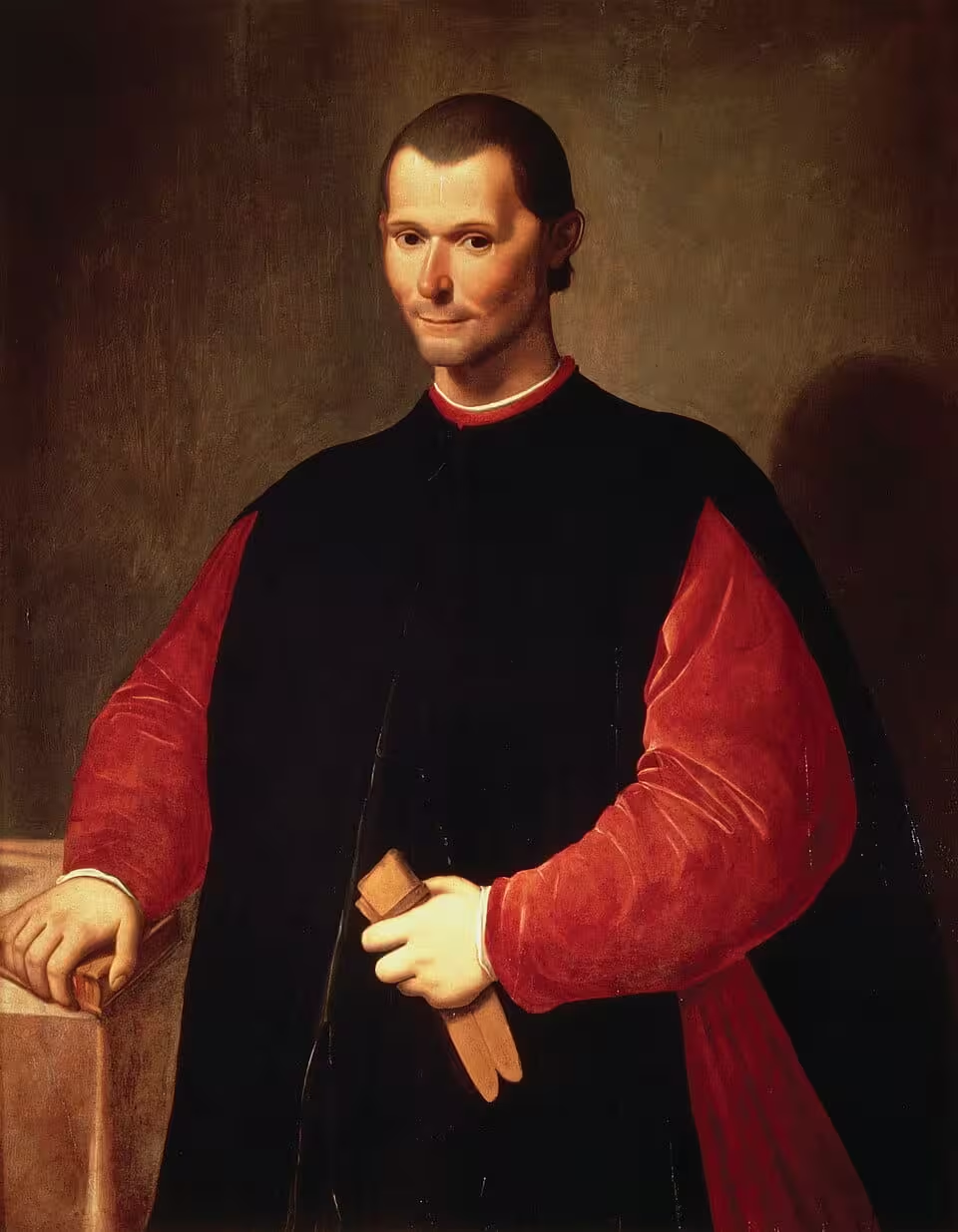
Niccolò Machiavelli
Niccolò Machiavelli was a Florentine diplomat, political thinker, and historian whose writings remade political realism. Living amid the violent rivalries of Renaissance Italy, he analyzed power as it actually operates—through fear, ambition, institutions, propaganda, and fortune—rather than as moral ideals wish it to be. The Prince became his most famous work, a hard-eyed handbook on statecraft and survival, while Discourses on Livy defended republican liberty, civic virtue, and strong institutions. Machiavelli’s enduring achievement is methodological: he made politics a domain to be studied empirically, as a craft governed by incentives, conflict, and the limits of human nature.
Key facts
- Florentine diplomat and political theorist central to Renaissance statecraft
- Author of The Prince and Discourses on Livy, two pillars of modern political thought
- Developed a realist approach to politics: study power as it is, not as it ought to be
- Key concepts: virtù (effective political capacity) and fortuna (chance/contingency)
- Also wrote major historical and literary works, including The History of Florence
Early life
Machiavelli was born in Florence during a period of intense political volatility. He received a humanist education in Latin and classical history, absorbing Roman political examples that later became central to his thought. Florence’s shifting regimes, factional struggle, and the pressures of foreign powers made politics unavoidable and formative. Rather than entering a noble or clerical path, he rose through civic service, where practical negotiation and institutional survival became his classroom.
Rise to prominence
Machiavelli rose to prominence as a senior official in the Florentine Republic, serving in diplomatic missions and military administration. He negotiated with and observed major figures of the era, witnessing firsthand the strengths and weaknesses of leaders and states. When the Medici returned to power, he was dismissed, imprisoned, and pushed into political exile. In that enforced distance, he wrote his most important works—transforming personal political defeat into a systematic anatomy of power, leadership, and republican stability.
Religion & philosophy
Machiavelli lived in a deeply Christian society, but his political writings treat religion primarily as a social and institutional force rather than a source of political truth. He admired religions when they cultivated civic discipline, unity, and courage, and he criticized religious forms that weakened political vitality or encouraged passivity. His stance is not simple atheism but political instrumentalism: in public life, beliefs matter because they shape obedience, morale, and collective identity.
Challenges
Machiavelli faced the central challenge of his time: Italy’s fragmentation, foreign invasions, mercenary unreliability, and internal factionalism. He wrote amid repeated regime collapse and the brutal consequences of weak institutions. Personally, he endured disgrace, torture, and exclusion from power. Intellectually, he confronted a moral problem that still unsettles readers: how to describe the necessities of power without endorsing cruelty for its own sake. His answer was unsettling clarity—separating moral purity from political survival and asking what preserves a state under real conditions.
Legacy
Machiavelli became a founding figure of modern political science and realism. “Machiavellian” entered language as a synonym for ruthless manipulation, yet his work is more complex: he admired republican liberty, warned against corruption, and emphasized institutions over mere personal cunning. His analysis of propaganda, military organization, elite conflict, popular power, and political legitimacy continues to shape thinkers across the spectrum—from republican theorists to realist strategists. Above all, his legacy is intellectual honesty about politics: power has laws of its own, and ignoring them invites catastrophe.
Death and succession
Machiavelli died in 1527, shortly after another political upheaval in Florence. He left no formal school, but his successors were the realist theorists and institutional thinkers who treated politics as a domain of incentives, conflict, and strategy. From early modern state builders to contemporary political analysis, Machiavelli’s “succession” is every attempt to understand governance without illusions, while still wrestling with the moral cost of necessity.