
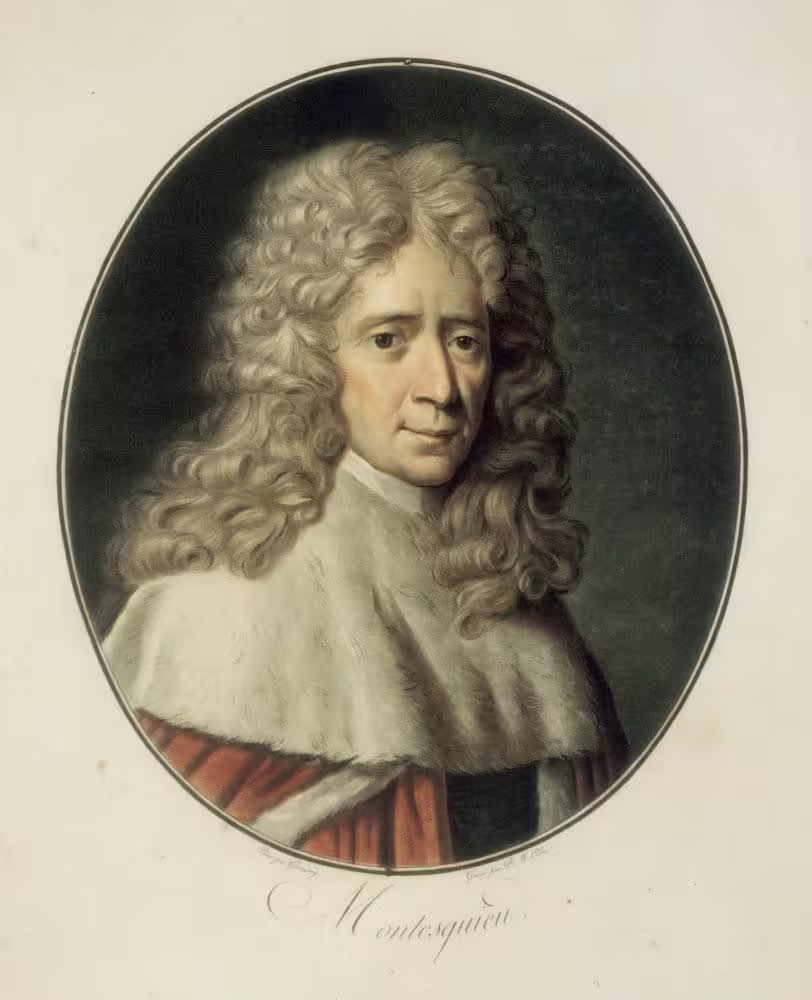
Montesquieu
Charles-Louis de Secondat, Baron de La Brède et de Montesquieu was a French political philosopher whose analysis of law, power, and institutions became foundational for modern constitutional government. In The Spirit of the Laws, he argued that political systems must be understood comparatively—shaped by history, culture, economics, and even climate—and that liberty depends on preventing the concentration of power. His most famous contribution is the theory of separation of powers, a structural solution to tyranny: distribute authority among distinct institutions so no single force can dominate. Montesquieu’s work helped define modern liberal constitutionalism and deeply influenced later democratic revolutions and state design.
Key facts
- Major Enlightenment political philosopher and pioneer of comparative political analysis
- Author of The Spirit of the Laws, a foundational work in modern constitutional theory
- Formulated the classic doctrine of separation of powers (legislative, executive, judicial)
- Argued that liberty depends on institutional checks and balance, not virtue alone
- Influenced modern constitutions, especially in the English-speaking world
Early life
Montesquieu was born into the French nobility near Bordeaux and trained in law. He inherited a position in the Parlement of Bordeaux (a regional high court), giving him practical exposure to legal institutions and the realities of governance. This legal background shaped his mature method: he treated political authority not as abstract ideal theory, but as something embodied in laws, courts, customs, and administrative structures. His early experience taught him that freedom and oppression are often produced by institutional design as much as by rulers’ intentions.
Rise to prominence
Montesquieu gained wide fame with Persian Letters, a satirical novel that used foreign observers to expose the absurdities and hypocrisies of French society. He then traveled through Europe, studying institutions—especially the English constitutional system—deepening his comparative approach. His greatest work, The Spirit of the Laws (1748), brought together decades of inquiry into a vast framework for understanding how different societies organize power, why certain laws fit certain peoples, and how constitutional forms can preserve liberty.
Religion & philosophy
Montesquieu wrote within a Catholic European context but approached religion primarily as one social institution among others—capable of supporting morality and civic order, but also capable of fanaticism and political manipulation. He argued for religious toleration and cautioned against merging spiritual authority with unchecked political power. His method was characteristically moderate: he sought stability, pluralism, and restraint rather than ideological purity or coercive uniformity.
Challenges
Montesquieu faced the challenge of writing political theory under a monarchy where direct criticism could invite censorship or worse. He therefore developed a careful, indirect style—irony, comparison, and institutional analysis—rather than revolutionary rhetoric. Intellectually, he confronted a deeper challenge: how to explain political differences without reducing everything to a single cause. His solution was multi-factor analysis—laws, economics, customs, geography, and historical development—producing a nuanced framework but also exposing him to criticism (especially for overemphasizing climate in some passages).
Legacy
Montesquieu’s separation of powers became one of the most influential ideas in constitutional history. His deeper legacy is the insight that liberty is preserved not by perfect rulers but by structures that restrain power through division, accountability, and legal process. He helped create modern comparative politics and constitutional design, encouraging societies to study institutions empirically rather than copy ideals blindly. His influence is visible wherever governments are built on checks and balances, independent courts, and a suspicion of concentrated authority.
Death and succession
Montesquieu died in 1755, a generation before the French Revolution. He founded no formal school, but his successors include constitutional framers, liberal theorists, and political scientists who treat institutions as the main defense against tyranny. The modern “succession” of Montesquieu is every constitutional system that tries to convert the moral problem of power into an architectural solution: divide it, balance it, and bind it to law.