
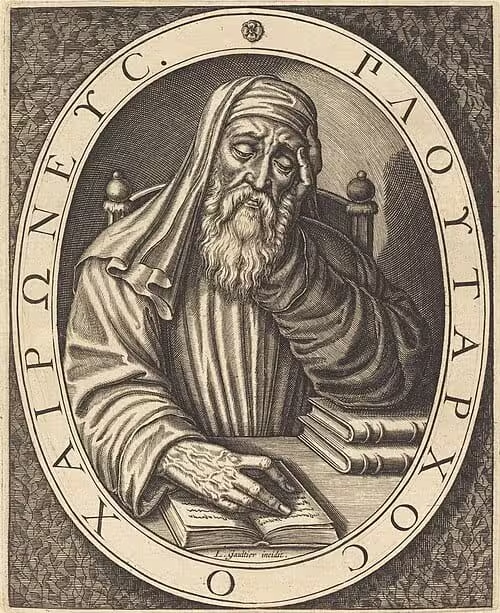
Plutarch
Plutarch was a Greek philosopher, biographer, and moralist of the early Roman Empire whose writings became one of the West’s greatest schools of character. Best known for Parallel Lives—a series pairing Greek and Roman statesmen—he used biography as moral education, showing how virtues and vices shape destinies more decisively than abstract theory. In Moralia, a vast collection of essays and dialogues, Plutarch explored ethics, religion, politics, friendship, and self-mastery with a humane and practical spirit. He stands at a unique crossroads: a Greek intellectual writing within Roman power, teaching that greatness is measured not only by conquest but by the quality of the soul.
Key facts
- Greek biographer and moral philosopher best known for Parallel Lives
- Author of Moralia, a wide-ranging collection of ethical essays and dialogues
- Used biography as moral instruction: character reveals itself in small actions and habits
- Influenced Renaissance humanism and later writers (including Shakespeare’s Roman plays)
- Blended Platonic philosophy with practical ethics and civic concern
Early life
Plutarch was born in Chaeronea, a small town in Boeotia, Greece, during the Roman imperial period. He studied philosophy—likely in Athens—and received a classical education in rhetoric, ethics, and history. Though he traveled and engaged with elite circles, he remained deeply attached to local civic life, serving his community and embodying a model of the philosophical citizen: educated, publicly responsible, and oriented toward virtue rather than fame.
Rise to prominence
Plutarch gained prominence through his learning, his teaching, and his ability to write moral literature with narrative power. His Parallel Lives made him famous by offering vivid portraits of leadership—ambition, courage, generosity, cruelty, prudence—using historical figures as mirrors for the reader’s own life. By pairing Greeks and Romans, he also built a cultural bridge, suggesting a shared moral vocabulary across civilizations. His work circulated widely because it was useful: it trained judgment, warned against vanity, and presented virtue as something concrete and observable.
Religion & philosophy
Plutarch lived within traditional Greco-Roman polytheism and served as a priest at Delphi, giving him an intimate relationship with ancient religious practice. He treated religion as morally and socially serious, defending reverence and piety while also interpreting myths philosophically. In many works he argues against crude superstition and insists that the gods should be understood in a way worthy of divine goodness. His religion is neither cynical nor naive: it aims to cultivate a sane, ethical reverence rather than fear-driven ritualism.
Challenges
Plutarch wrote in a world where Greece was politically subordinate to Rome, and he had to negotiate cultural pride without political power. His challenge was to preserve Greek intellectual authority while also honoring Roman civic achievement. Philosophically, he faced the difficulty of moral education: how to shape character in readers not through rigid doctrine but through example, reflection, and self-recognition. He also had to work with imperfect historical sources, and he openly prioritized moral insight over strict chronological or documentary precision.
Legacy
Plutarch became a foundational author for moral and civic education across centuries. Parallel Lives influenced Renaissance statesmen, educators, and writers, and it shaped later biography as a serious genre. His portraits of ambition and virtue informed political thought, while his moral essays offered guidance on anger, friendship, superstition, leadership, and self-control. His enduring legacy is the idea that character is destiny—and that history’s greatest value is to train the soul, not merely to record events.
Death and succession
Plutarch likely died in the early 2nd century CE. He founded no formal school, but his successors are the moralists, historians, educators, and political thinkers who treat lives as lessons. From Renaissance humanists to modern leadership readers, Plutarch’s “succession” is the continuous belief that the best way to learn virtue is to watch it tested in the lives of the great.