
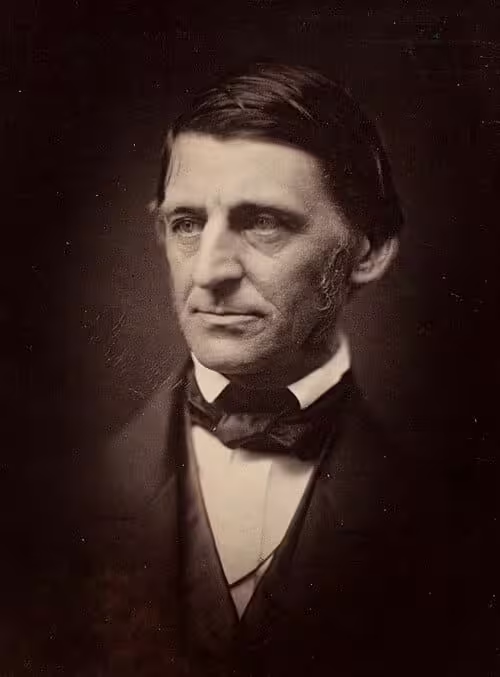
Ralph Waldo Emerson
Ralph Waldo Emerson was an American essayist, lecturer, and philosophical writer who became the central voice of Transcendentalism. He taught a radical confidence in the individual mind, urging people to trust conscience, reject dead conformity, and live from first principles rather than borrowed opinions. In works like Nature and “Self-Reliance,” Emerson fused moral seriousness with spiritual independence: the world is meaningful, the self is capable of insight, and the highest duty is to become a free, awake human being. His influence shaped American literature, education, reform movements, and the modern language of authenticity and personal responsibility.
Key facts
- Leading figure of American Transcendentalism and one of the greatest American essayists
- Author of Nature (1836) and Essays (First Series) (1841), including “Self-Reliance”
- Famous lecturer whose talks shaped 19th-century American public life
- Argued for intellectual independence: trust your own judgment over social conformity
- Influenced major writers including Thoreau, Whitman, and many later American thinkers
Early life
Emerson was born in Boston into a family of ministers and grew up amid both intellectual tradition and financial uncertainty. He studied at Harvard and trained for the ministry, developing strong habits of reading, note-taking, and moral reflection. Early loss and responsibility deepened his inwardness, while his education exposed him to classical philosophy, Christian theology, and emerging European thought—ingredients that later fused into his distinctive American voice.
Rise to prominence
Emerson’s rise began with a decisive break: he left the ministry, unwilling to continue forms of worship that felt spiritually empty to him. He turned to writing and lecturing, building a public career around ideas that were simultaneously philosophical and practical—how to think, how to live, how to resist conformity. Nature announced a new vision of the self in relation to the world, and his essays became a kind of moral literature for democracy: short, concentrated works that trained readers to become independent, courageous, and inwardly disciplined.
Religion & philosophy
Emerson moved from orthodox Christianity toward a more personal, universal spirituality. He did not reject the sacred; he relocated it—away from fixed dogma and toward direct experience, conscience, and the living presence of nature. His Transcendentalism treats the moral law inside the person as real and authoritative, and it treats nature as a symbolic and spiritual teacher. He valued religion when it awakened character, and distrusted it when it became mere institution, fear, or imitation.
Challenges
Emerson’s ideas faced resistance in a culture where religious and social conformity were strong. He was criticized for perceived unorthodoxy and for speaking in a style that valued insight and provocation over systematic argument. Personally, he endured profound grief, including the death of close family members, which tested his philosophy’s optimism. Intellectually, he also faced a tension that runs through his work: how to celebrate the sovereign individual while still honoring community, justice, and the demands of moral responsibility.
Legacy
Emerson helped create an American tradition of moral and intellectual independence. His essays shaped modern ideas of self-culture, education, leadership, and creativity, and his language became part of the cultural bloodstream—calling people back to courage, simplicity, and integrity. He influenced literature (from Thoreau and Whitman onward), reform movements, and modern self-development writing, but his best legacy is sterner than motivational slogans: a demand for honesty, disciplined thought, and a life aligned with conscience.
Death and succession
Emerson died in 1882 after years of declining health and memory loss. He founded no formal school, but his successors are the writers and thinkers who treat the individual mind as a moral power and the purpose of education as awakening. From American pragmatists to modern essayists, Emerson’s “succession” continues wherever people insist on thinking for themselves and living without inner surrender.