
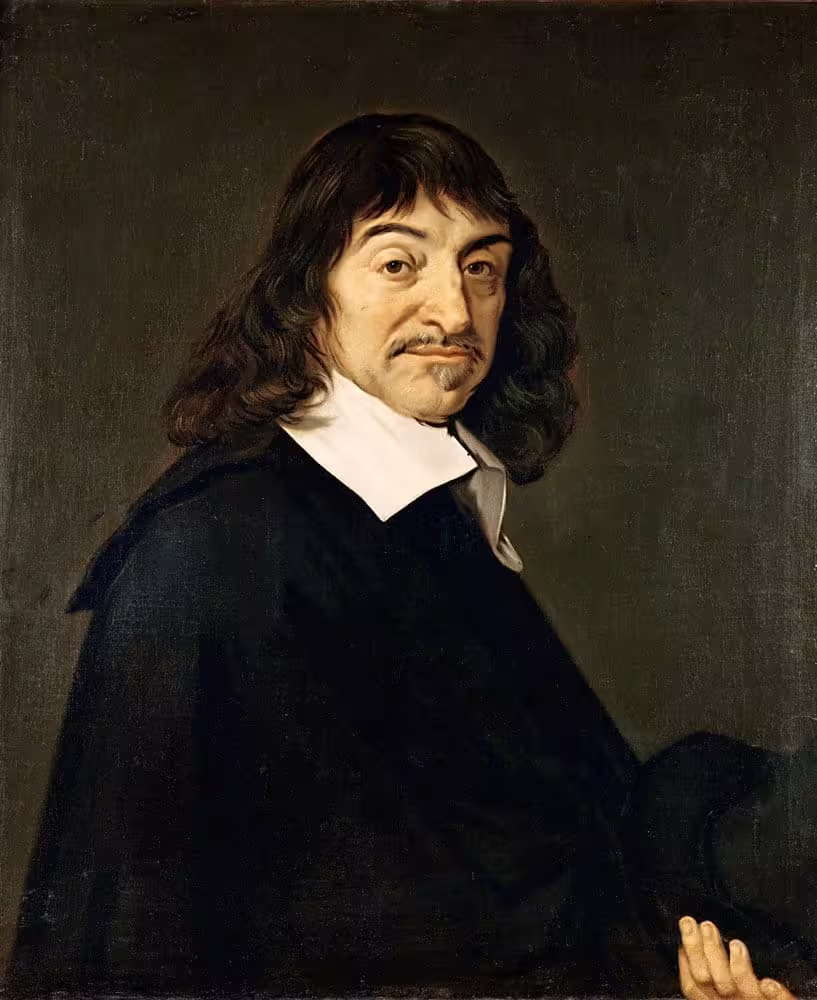
René Descartes
René Descartes was a French philosopher, mathematician, and scientist whose search for certainty helped launch modern philosophy. He introduced a new method of radical doubt—discarding every belief that could be questioned—in order to discover a foundation that could not be shaken. From this came his most famous insight: “I think, therefore I am,” the claim that conscious thought proves the existence of the thinking self. Descartes then rebuilt knowledge around clear and distinct ideas, separating mind and body into two distinct substances and shaping debates in metaphysics, epistemology, and science for centuries. In mathematics, his development of analytic geometry helped unite algebra and geometry, influencing the rise of modern physics and the Scientific Revolution.
Key facts
- Founder of modern Western philosophy and a key figure in the Scientific Revolution
- Famous for methodological doubt and the cogito (“I think, therefore I am”)
- Developed mind–body dualism: res cogitans (thinking substance) vs res extensa (extended substance)
- Major works include Discourse on the Method and Meditations on First Philosophy
- Created analytic geometry, linking algebra with geometry (Cartesian coordinates)
Early life
Descartes was born in La Haye en Touraine in France and educated at the Jesuit college of La Flèche, where he studied classical learning, philosophy, and mathematics. Though impressed by mathematics, he became dissatisfied with the uncertainty and disagreement he found in traditional scholastic philosophy. After schooling, he spent years traveling and serving as a soldier in Europe, using the time to observe human life, reflect on knowledge, and develop the intellectual discipline that would later define his philosophical method.
Rise to prominence
Descartes became prominent through a combination of philosophical writing and scientific work. His Discourse on the Method presented a new approach to inquiry: start from simple, certain steps; divide problems; proceed systematically; and accept only what can be clearly justified. His Meditations then offered a dramatic philosophical narrative—doubt, discovery of the self, proof of God, and the rebuilding of knowledge—written to establish philosophy on firm foundations. His scientific ambitions were inseparable from this project: he wanted a complete system where physics, biology, and metaphysics formed a coherent whole.
Religion & philosophy
Descartes wrote within a Christian Europe and sought to make his philosophy compatible with faith while also protecting scientific inquiry from theological control. In his Meditations, he argued for God’s existence and used God’s non-deceptive nature to defend the reliability of clear and distinct ideas. Yet his approach provoked controversy because it shifted authority from tradition to individual reason and method. His attempt to balance rational inquiry with religious orthodoxy shaped how early modern thinkers navigated censorship and suspicion.
Challenges
Descartes worked during a time of intellectual and religious tension, when new science could be seen as a threat to established authority. He was cautious about publication, especially after Galileo’s condemnation, and often tried to present his ideas in ways that avoided direct conflict. Philosophically, his greatest challenge was to escape skepticism without returning to dogma: how to justify knowledge of the external world, the existence of God, and the connection between mind and body. His dualism also created a lasting problem—how two different kinds of substance can interact—an issue that shaped subsequent philosophy.
Legacy
Descartes is often called the “father of modern philosophy” because he shifted the center of inquiry to the knowing subject and the demand for methodological justification. His dualism, his emphasis on reason, and his search for certainty shaped rationalism and provoked the empiricist response. In science and mathematics, his analytic geometry became a fundamental tool for modern physics. Even thinkers who reject his conclusions inherit his ambition: to build knowledge on reasons that can withstand doubt.
Death and succession
Descartes died in 1650 in Stockholm, Sweden, where he had been invited to teach philosophy. His successors included rationalists such as Spinoza and Leibniz, as well as critics like Locke and Hume who challenged his assumptions about innate ideas and certainty. Across modern philosophy, Descartes’s “succession” is the continuing demand to justify belief through method and to begin inquiry from what can be known with clarity.