
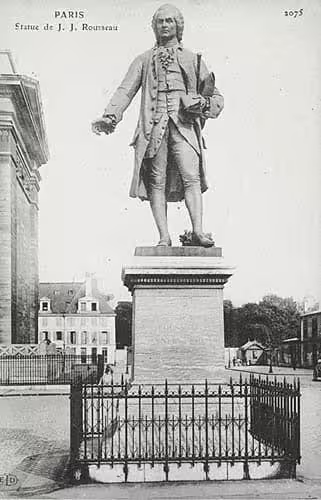
Jean-Jacques Rousseau
Jean-Jacques Rousseau was a Genevan-born philosopher, writer, and composer whose work transformed modern ideas of freedom, equality, education, and political legitimacy. He argued that civilization often corrupts natural human compassion and independence, producing vanity, inequality, and dependence. In The Social Contract, he redefined political authority as legitimate only when grounded in the “general will” of free and equal citizens. In Émile, he revolutionized educational thought by insisting that education should form character and freedom rather than merely train obedience. Rousseau’s influence shaped the French Revolution, romanticism, modern republicanism, and continuing debates about democracy, identity, and moral authenticity.
Key facts
- Major Enlightenment figure whose work reshaped modern political and educational theory
- Author of The Social Contract, Discourse on Inequality, and Émile
- Developed the idea of the “general will” as the basis of legitimate political authority
- Critic of social vanity, status competition, and inequality produced by modern civilization
- Pioneered modern autobiographical self-examination in Confessions
Early life
Rousseau was born in Geneva, where his mother died shortly after his birth. Raised by his father, he encountered early both affection and instability, and his youth included periods of wandering, apprenticeship, and dependence on patrons. These experiences—outsider status, social humiliation, and longing for independence—became central themes in his philosophy. Over time he moved through Swiss and French cultural circles, gradually forming his distinctive voice: passionate, moral, suspicious of elite sophistication, and intensely concerned with human freedom.
Rise to prominence
Rousseau rose to prominence after winning a prize essay contest with a provocative thesis: progress in arts and sciences does not necessarily improve morals and may even corrupt them. He followed with major works that deepened the critique, arguing that inequality is not simply natural but socially constructed—especially through property, comparison, and dependence. His writings combined philosophical argument with a powerful moral psychology and literary force, making him one of the most widely read and contested thinkers of the 18th century.
Religion & philosophy
Rousseau’s religious views were complex and controversial. He rejected strict orthodoxy and theological authority, but defended a form of natural religion centered on conscience, gratitude, and reverence for moral order. In Émile, his “Profession of Faith of the Savoyard Vicar” presented a vision of sincere faith grounded in inner conviction rather than dogma—an approach that outraged religious authorities. For Rousseau, religion should support virtue and civic trust, not become an instrument of coercion or sectarian domination.
Challenges
Rousseau lived in constant tension with the intellectual world he influenced. His works on education and religion were condemned and sometimes banned, forcing him into flight and exile. He clashed with leading Enlightenment figures and suffered from paranoia, social conflict, and an acute sense of persecution. Philosophically, he faced a deep problem: how to reconcile individual freedom with collective political authority, and how to imagine a society that produces equality without crushing personal authenticity.
Legacy
Rousseau became a foundational source for modern democratic and revolutionary thought, especially through the idea that political legitimacy depends on the people as a whole rather than inherited hierarchy. He also shaped modern conceptions of authenticity, emotion, and the self, influencing romanticism and later social critique. His educational ideas—develop the child’s natural capacities, protect curiosity, form character through experience—remain enduring. At the same time, his concept of the general will has been fiercely debated: seen by some as the highest ideal of civic freedom, and by others as vulnerable to authoritarian misuse when “the people” are claimed as a single voice.
Death and succession
Rousseau died in 1778, not living to see the French Revolution that would adopt and transform many of his ideas. His successors included revolutionary theorists, romantic writers, modern republicans, and critics of modern consumer society. Even his enemies inherited his central questions: What makes a society legitimate? How can equality exist without domination? And how do individuals remain free and human within the pressures of civilization?