
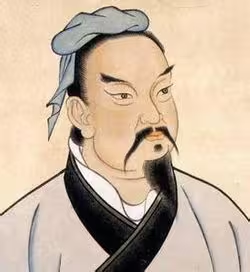
Sun Tzu
Sun Tzu was the legendary Chinese strategist traditionally credited with The Art of War, the most influential manual of strategy ever written. Whether a single historical general or a name representing an evolving military tradition, the work associated with him distilled war into principles of intelligence, deception, morale, timing, and political purpose. Sun Tzu treats conflict as a rational art: win by shaping conditions, not by reckless force; defeat the enemy’s strategy before their armies; and treat victory as the outcome of superior information and disciplined leadership. Across centuries, The Art of War has been read not only by soldiers but by statesmen and executives as a guide to competitive advantage under pressure.
Key facts
- Traditionally credited author of The Art of War (Sunzi Bingfa)
- Core principles: intelligence, deception, speed, discipline, and indirect attack
- Emphasized winning without battle as the highest form of skill
- Stressed alignment of military action with political objectives and state survival
- Enduring influence on military theory, statecraft, and modern competitive strategy
Early life
Details of Sun Tzu’s life are uncertain and mixed with legend. Traditional accounts place him in the Spring and Autumn Period, a time of competing states and constant warfare, where strategic skill could determine survival. The world that produced The Art of War valued disciplined command, careful planning, and knowledge of terrain, logistics, and morale. Whether Sun Tzu was a single figure or a composite tradition, the text reflects a practitioner’s mind: concise, unsentimental, and focused on results.
Rise to prominence
Sun Tzu’s prominence comes from the authority and longevity of The Art of War. The text became a foundational classic of Chinese military thought and was studied by commanders and officials for centuries. Its style—short chapters, aphoristic maxims, and practical rules—suggests a work designed for training leaders. It rose beyond its original context because its principles describe not only battle tactics but decision-making under uncertainty: when to act, when to wait, how to mislead, and how to conserve strength while exhausting an opponent.
Religion & philosophy
The Art of War is not a religious text, but it is shaped by classical Chinese views of harmony, order, and alignment with “the way” of circumstances. Sun Tzu treats victory as the product of correct positioning within nature and human psychology—understanding patterns, timing, and the moral forces that hold an army together. The closest equivalent to “spiritual” in the work is its insistence on internal unity and clarity of command: disorder within is defeat already beginning.
Challenges
The central challenge addressed by Sun Tzu is how to secure the state while minimizing destruction. War is costly, unpredictable, and politically dangerous, so the strategist must pursue victory with economy. Sun Tzu also confronts the problem of limited information: leaders must act without complete certainty. His solution is intelligence and adaptability—spies, reconnaissance, deception, flexible formations, and the ability to change plans as conditions change. He assumes that brute courage is insufficient; disciplined calculation is what wins.
Legacy
Sun Tzu’s legacy is global: The Art of War became one of the most translated and widely applied strategy texts in history. In East Asia it influenced military doctrine and statecraft; in the modern world it has been adopted in business, politics, negotiation, and sport. Its enduring power comes from its realism: conflict is about incentives, perception, and structure, not just force. Sun Tzu’s deeper legacy is a philosophy of strategic restraint—win efficiently, avoid prolonged struggle, and treat violence as a last resort guided by reason.
Death and succession
If Sun Tzu was a historical individual, he likely lived and died in the 5th century BCE; exact details are unknown. His “succession” is the long tradition of Chinese strategic thought and the generations of commanders and readers who treated The Art of War as a manual for disciplined decision-making. The work’s survival across eras is itself the strongest evidence of its authority: it continues to describe how advantage is created when stakes are high and uncertainty is permanent.