
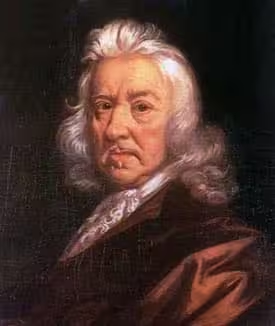
Thomas Hobbes
Thomas Hobbes was an English philosopher whose political theory helped found modern social contract thought. Writing in the shadow of civil war and state collapse, he argued that political authority is justified primarily because it prevents violent disorder. In Leviathan, Hobbes describes the “state of nature” as a condition where no common power exists to restrain conflict—making life “solitary, poor, nasty, brutish, and short.” To escape this, rational individuals covenant to authorize a sovereign with sufficient power to enforce peace. Hobbes’s realism about fear, self-interest, and coercion shaped later debates about authority, rights, and the foundations of political legitimacy.
Key facts
- Major English political philosopher and key architect of modern social contract theory
- Author of Leviathan (1651), his most influential work
- Famous for the “state of nature” and the need for a strong sovereign to secure peace
- Materialist thinker who explained mind and society in mechanistic terms
- Wrote amid the English Civil War, shaping his focus on order and stability
Early life
Hobbes was born in Westport near Malmesbury as the Spanish Armada approached, later joking that “fear and I were born twins.” His father, a clergyman, fled after a scandal, leaving Hobbes to be raised by his uncle. He studied at Magdalen Hall, Oxford, receiving a classical education, and then entered the service of the Cavendish family as tutor—an association that shaped his life through travel, patronage, and exposure to European intellectual networks.
Rise to prominence
Hobbes’s prominence grew through decades of writing on logic, language, politics, and human nature. He traveled in Europe, interacted with leading thinkers, and absorbed the new scientific methods of his age. The crisis of the English Civil War pushed his political theory into its most forceful form: Leviathan offered not only a diagnosis of political breakdown but a construction plan for authority capable of ending it. His willingness to argue for strong centralized power—grounded in secular reasoning rather than divine right—made him both influential and controversial.
Religion & philosophy
Hobbes lived in a deeply Christian society but was often suspected of irreligion because he treated religion and church authority as political problems as much as theological ones. He argued that religious conflict is a major source of civil disorder and that interpretations of scripture should not undermine public peace. In Leviathan, he attempted to reconcile Christianity with political sovereignty by subordinating church power to the civil authority, insisting that unity of command is necessary to prevent sectarian chaos.
Challenges
Hobbes faced the danger of writing political theory in a revolutionary era. His ideas angered royalists and parliamentarians alike, and his secular, mechanistic explanations of human life drew accusations of atheism. He also confronted a hard philosophical challenge: how to justify absolute or near-absolute sovereignty while still claiming it arises from rational consent. His answer was stark: without enforceable authority, rights are empty and security collapses; therefore, peace is the first political good, and coercive power is the price of civilization.
Legacy
Hobbes permanently reshaped political philosophy by making security and order central to the justification of the state. His social contract framework influenced later thinkers even when they rejected his conclusions—Locke and Rousseau both argued against Hobbes while inheriting his method. Modern debates about authoritarianism, emergency powers, the role of fear, and the trade-off between liberty and security still echo Hobbes’s core insight: politics begins where violence is restrained by a common power.
Death and succession
Hobbes died in 1679 after a long life of writing and controversy. He founded no formal school, but his successors include realists, contract theorists, and modern political scientists who treat power and coercion as unavoidable features of political order. His “succession” is every theory of the state that begins from worst-case human conflict and asks what institutions can reliably prevent it.