
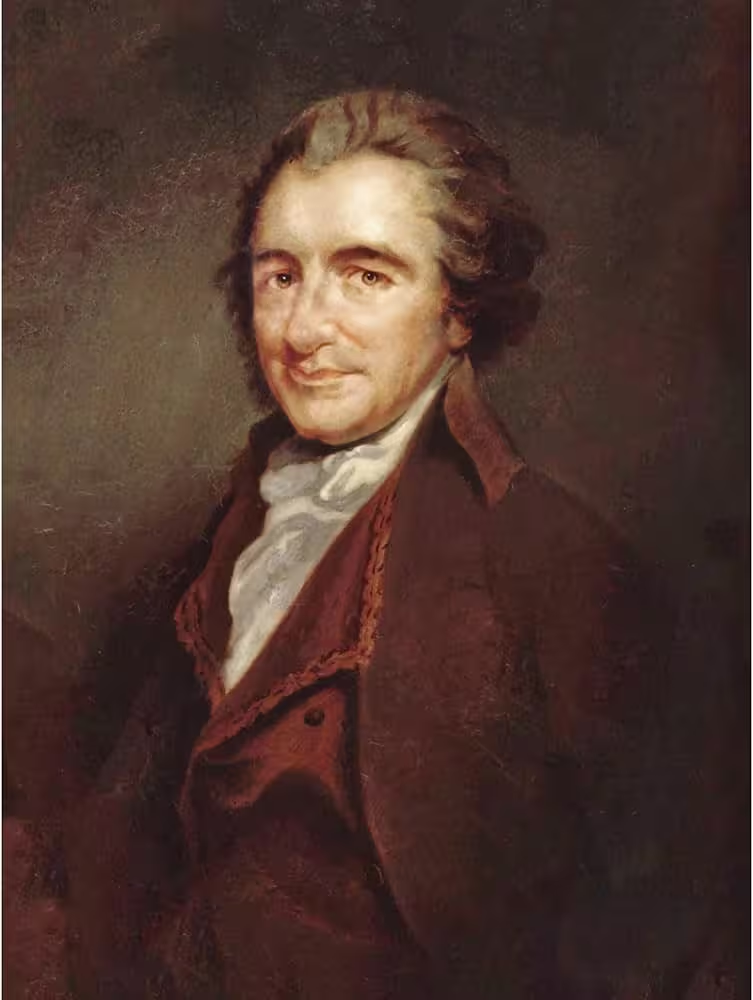
Thomas Paine
Thomas Paine was an English-born revolutionary writer whose pamphlets helped ignite democratic politics in the modern world. With a direct, forceful style aimed at ordinary readers, he made radical ideas sound like common sense. Common Sense pushed public opinion toward American independence, The American Crisis sustained morale during the war, and Rights of Man defended popular sovereignty against hereditary rule. Later, The Age of Reason argued for deism and attacked religious dogma, making him both celebrated and scandalous. Paine’s legacy is the political power of plain language: philosophy and liberty written for the public, not the elite.
Key facts
- Author of Common Sense (1776), a decisive pamphlet for American independence
- Wrote The American Crisis (“These are the times that try men’s souls”) during the Revolutionary War
- Defended popular sovereignty and natural rights in Rights of Man (1791–1792)
- Advocated democratic reform and criticized monarchy and hereditary privilege
- Promoted deism and religious skepticism in The Age of Reason (1794–1795)
Early life
Paine was born in Thetford, England, into a modest family and worked various trades and jobs before finding his voice as a political writer. He experienced the insecurity and frustration of ordinary life under rigid social hierarchy, which shaped his later moral intensity about equality and opportunity. After struggling to establish himself in England, he emigrated to the American colonies in 1774, arriving with little status but enormous ambition to speak to the public directly.
Rise to prominence
Paine rose to prominence almost overnight with Common Sense, which argued that independence was not only desirable but inevitable and morally necessary. He wrote in a new political register—urgent, accessible, and emotionally compelling—turning abstract Enlightenment principles into a mass movement. During the war, The American Crisis essays helped sustain resolve when defeat seemed likely, cementing his reputation as a writer whose words could move events.
Religion & philosophy
Paine’s religious outlook was broadly deist: he affirmed a creator and moral order while rejecting revealed religion, priestly authority, and doctrinal coercion. In The Age of Reason, he criticized superstition and argued that true religion should be compatible with reason and conscience. His views provoked intense backlash, especially in more traditional religious environments, and contributed to his later political isolation despite his earlier revolutionary fame.
Challenges
Paine’s life was marked by controversy and political danger. His defense of the French Revolution and republican principles made him enemies in both Britain and America, and in France he was imprisoned during the Terror. He also struggled with the costs of public radicalism: shifting alliances, accusations of impiety, and the long-term social penalty of challenging religious and political institutions simultaneously. He remained committed to principle even when it damaged his reputation and security.
Legacy
Paine helped prove that political writing can change history when it speaks clearly to the public. He shaped modern democratic rhetoric around equality, rights, and government as a human-made tool rather than a sacred inheritance. His pamphlets influenced later reform movements—labor, abolition, universal suffrage—and his insistence that legitimacy comes from the people became a defining modern idea. Even critics acknowledge his rare achievement: turning revolutionary theory into mass persuasion.
Death and succession
Paine died in 1809 in New York after years of diminished standing, though his influence outlived his reputation. He founded no party or school, but his successors are every generation of democratic reformers who use plain speech to challenge inherited power. Wherever political legitimacy is argued as a matter of reason, rights, and popular consent, Paine’s voice still echoes.