
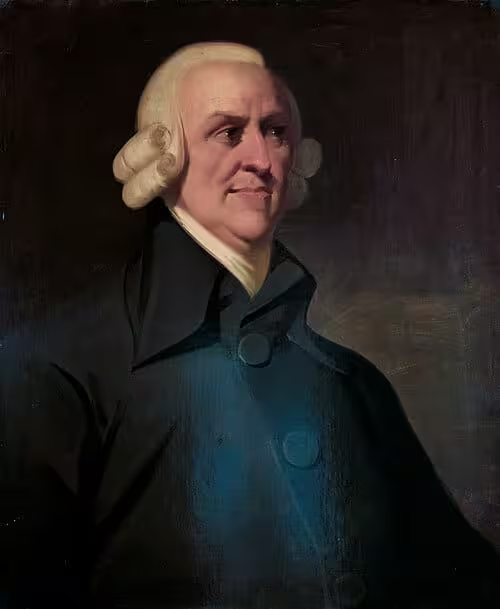
Adam Smith
Adam Smith was a Scottish moral philosopher and political economist whose writings shaped modern thinking about markets, morals, and institutions. Best known for The Wealth of Nations (1776) and The Theory of Moral Sentiments (1759), he argued that prosperity grows through specialization, trade, and stable laws—while insisting that conscience, justice, and social trust are the moral foundation of public life.
Key facts
- Professor of Moral Philosophy at the University of Glasgow
- Published The Theory of Moral Sentiments (1759)
- Published The Wealth of Nations (1776)
- Key figure of the Scottish Enlightenment; close friend of David Hume
- Served as a Commissioner of Customs in Scotland in later life
Early life
Adam Smith was born in Kirkcaldy, a coastal town in Scotland. His father, a customs official, died before Smith was born, and he was raised primarily by his mother, to whom he remained deeply devoted. He studied at the University of Glasgow and later at Oxford, developing an early passion for philosophy, rhetoric, and moral psychology. Even as a young scholar, Smith was known for intense focus and long, careful thought.
Rise to prominence
Smith first gained recognition through public lectures that blended moral philosophy, jurisprudence, and political economy. He later became Professor of Moral Philosophy at Glasgow, where his teaching shaped a generation of students and provided the intellectual foundation for his major works. The Theory of Moral Sentiments established him as a leading thinker on conscience and virtue, and The Wealth of Nations later made him the central architect of classical political economy—linking prosperity to division of labor, trade, and institutional stability.
Religion & philosophy
Smith wrote in a culture shaped by Scottish Presbyterian life, but his work is primarily philosophical rather than theological. His moral theory emphasizes sympathy, conscience, and justice as features of human social life, and his political economy focuses on institutions and incentives. He generally avoids sectarian argument, aiming for moral and social principles that can be defended by reason and observation.
Challenges
Smith lived during an era of rapid political and economic change, with intense debates over trade, empire, poverty, and taxation. He also faced the difficulty of writing for a public sphere that often demanded slogans rather than nuance: his views are frequently simplified into clichés. In private life, he was cautious and meticulous, and late in life he famously chose to have many unpublished papers destroyed—suggesting high standards and a fear of leaving unfinished work behind.
Legacy
Adam Smith’s influence spans economics, moral philosophy, and public policy. He helped define how modern societies think about markets, prices, specialization, and the dangers of monopoly and captured regulation. Just as importantly, he argued that social cooperation depends on justice, trust, and moral self-command. Today he remains a key reference point for debates about capitalism, inequality, regulation, and the moral limits of economic life.
Death and succession
Smith died in Edinburgh in 1790. In his final years he worked on revisions and oversaw the careful handling of his legacy, including the destruction of many unpublished manuscripts. His ideas lived on through later economists and philosophers, shaping the development of classical economics and influencing political thought across Europe and the Americas.