
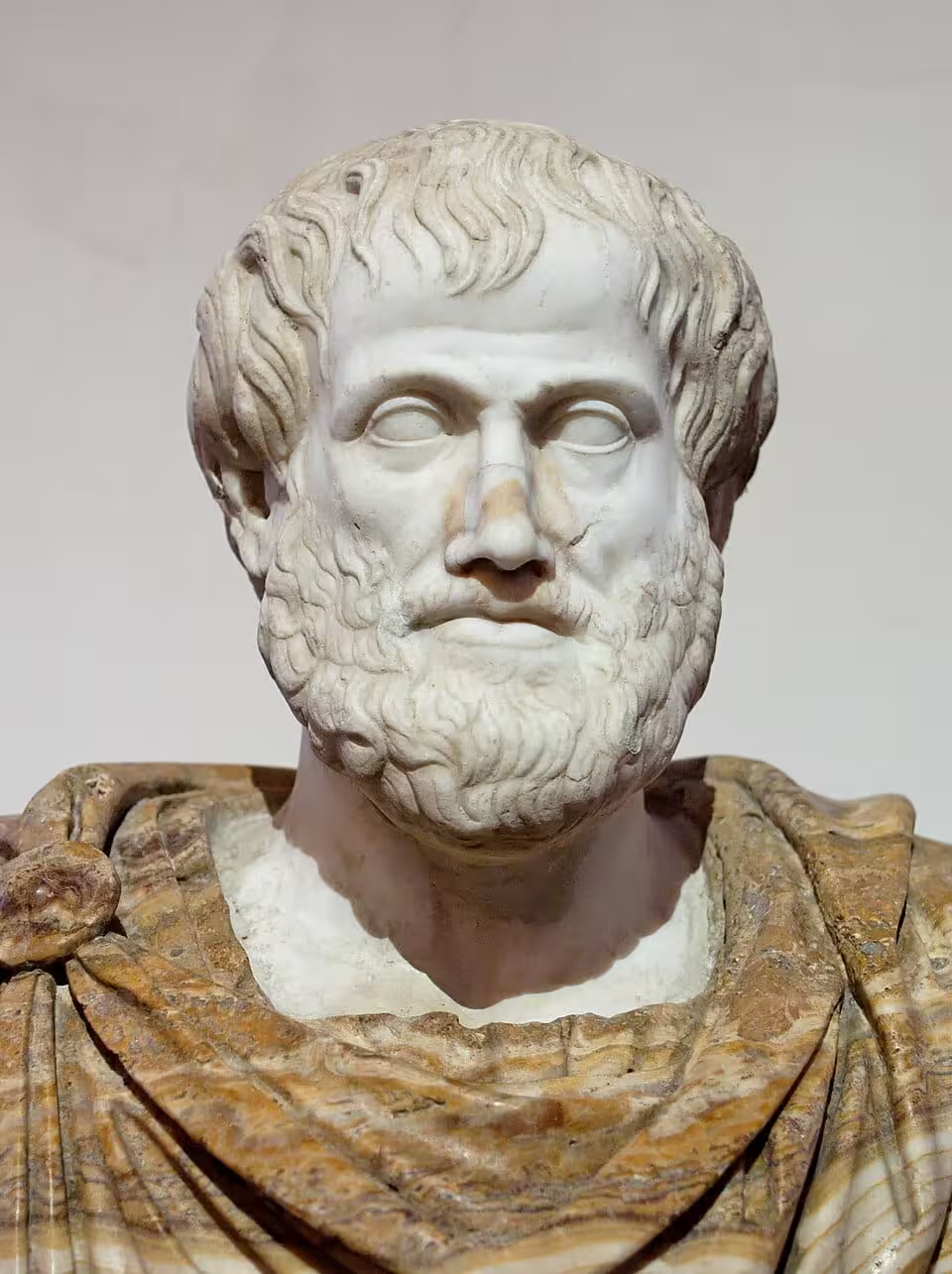
Aristotle
Aristotle was an ancient Greek philosopher and scientist whose work shaped logic, ethics, politics, biology, and metaphysics. A student of Plato and tutor to Alexander the Great, he founded the Lyceum in Athens and pioneered a systematic, empirical approach to knowledge that influenced Western and Islamic thought for centuries.
Key facts
- Student of Plato at the Academy for about 20 years
- Tutor to Alexander the Great (c. 343–340 BCE)
- Founded the Lyceum in Athens and led the Peripatetic school (c. 335 BCE)
- Wrote foundational works in logic (Organon), ethics, politics, and natural science
- Developed virtue ethics, the doctrine of the mean, and key ideas in formal logic
Early life
Aristotle was born in Stagira in northern Greece. His father, Nicomachus, served as court physician to the Macedonian royal family, which likely shaped Aristotle’s early interest in biology and observation. Orphaned young, Aristotle was sent to Athens and entered Plato’s Academy, where he studied and taught for nearly two decades.
Rise to prominence
After Plato’s death, Aristotle left Athens and spent years teaching and researching in Asia Minor and on the island of Lesbos, where he pursued close studies of animals and marine life. He was later invited to Macedonia to tutor the young Alexander. Returning to Athens around 335 BCE, he founded the Lyceum—an institution devoted to research, lectures, and the collection of knowledge—quickly becoming one of the most influential thinkers of the ancient world.
Religion & philosophy
Aristotle’s philosophy treats the divine primarily through reasoned metaphysics rather than traditional mythology. He argued for an ultimate principle often called the Unmoved Mover—pure actuality and the final cause of cosmic motion. His approach to theology was philosophical and became highly influential in later medieval Jewish, Christian, and Islamic thought.
Challenges
Aristotle lived through intense political instability between Athens and Macedon. After Alexander the Great’s death, anti-Macedonian sentiment rose in Athens, and Aristotle—associated with Macedonia—faced accusations of impiety. He left Athens to avoid a fate he described as the city ‘sinning twice against philosophy,’ and spent his final year in exile in Chalcis.
Legacy
Aristotle’s influence is foundational across multiple disciplines. His works shaped medieval scholasticism and the development of logic, ethics, and political theory, while his empirical studies helped set a pattern for scientific investigation. His concept of virtue as cultivated habit, his analysis of constitutions, and his methods of reasoning remained core reference points for centuries.
Death and succession
Aristotle died in Chalcis in 322 BCE. Leadership of the Lyceum passed to his student Theophrastus, who continued the Peripatetic tradition and expanded Aristotle’s work in natural science. Aristotle’s writings were preserved and transmitted through complex historical pathways, later becoming central texts in both the Islamic world and medieval Europe.