
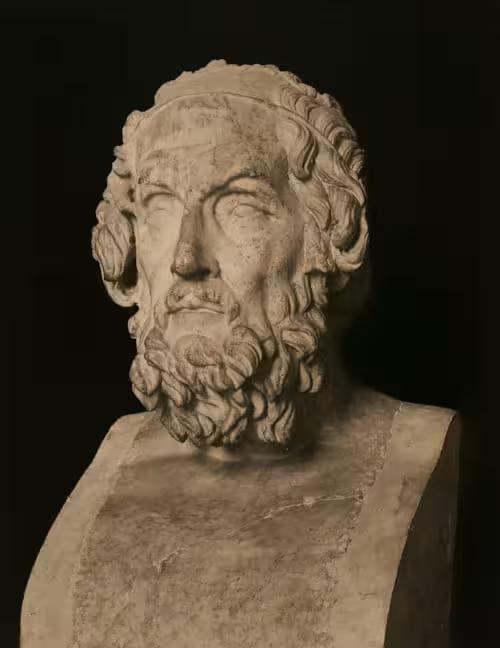
Epictetus
Epictetus was a Stoic philosopher who taught that freedom is self-rule: mastering judgment, desire, and fear rather than trying to control the outer world. Born enslaved and later freed, he became one of Stoicism’s greatest teachers. His lectures were recorded by his student Arrian as the Discourses, and later distilled into the Enchiridion (Handbook), making Epictetus the most practical and discipline-focused voice in the Stoic tradition.
Key facts
- Born enslaved; later gained freedom and taught philosophy
- Taught in Rome until philosophers were expelled, then founded a school in Nicopolis
- His teachings survive through Arrian’s Discourses (four books) and the Enchiridion (Handbook)
- Central idea: the dichotomy of control—what is up to us vs. what is not
- Major influence on later Stoics, including Marcus Aurelius
Early life
Epictetus was born in Hierapolis in Phrygia (in the eastern Roman Empire) and spent his early life as an enslaved person in Rome. Despite his status, he studied Stoic philosophy under Musonius Rufus. His experience of constraint and dependency helped shape his emphasis on inner freedom: even when the body is controlled, judgment and moral purpose can remain sovereign.
Rise to prominence
After gaining freedom, Epictetus taught in Rome and became known for a blunt, training-oriented style: philosophy as daily practice rather than elegant theory. When Emperor Domitian expelled philosophers from Rome, Epictetus relocated to Nicopolis in Greece and established a school that attracted students from across the empire. Arrian, one of his most devoted students, recorded Epictetus’s talks, preserving a living voice of Stoic instruction rather than a polished treatise.
Religion & philosophy
Epictetus’s Stoicism is religious in a rational sense: he speaks of Zeus and divine providence as the order of nature and urges gratitude and alignment with it. His focus is not ritual but moral seriousness—accepting what we cannot control, doing our duty, and living in harmony with reason and nature.
Challenges
Epictetus’s central challenge was lived hardship: enslavement, social powerlessness, and later political expulsion. He turned these conditions into proof of his philosophy: if freedom is an inner achievement, then even severe external limits cannot destroy it. His teaching constantly attacks vanity, approval-seeking, and “performing philosophy” as substitutes for real discipline.
Legacy
Epictetus became one of the most influential moral teachers in the Western tradition. His emphasis on judgment, resilience, and self-command shaped Stoicism’s later popularity and directly influenced Marcus Aurelius. The Enchiridion, in particular, became a long-lived manual for inner discipline, copied and read for centuries in both pagan and Christian contexts. Today Epictetus remains a primary source for practical Stoicism: simple principles that cut through anxiety and restore moral clarity.
Death and succession
Epictetus likely died in Nicopolis in the early 2nd century CE. Because he left no writings of his own, his intellectual succession depends on Arrian’s faithful recording. Through those texts, Epictetus’s school lived on as a tradition of moral training, and his influence continues wherever people seek calm strength under pressure.