
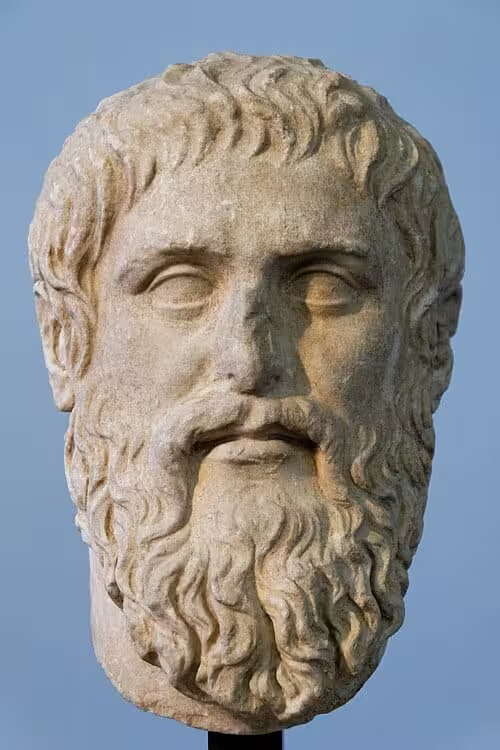
Plato
Plato was an ancient Greek philosopher, student of Socrates, and teacher of Aristotle. He founded the Academy in Athens, the first institution of higher learning in the Western world. His dialogues have shaped philosophy, politics, and education for over two millennia.
Key facts
- Founded the Academy in Athens (c. 387 BCE)
- Student of Socrates; teacher of Aristotle
- Wrote over 30 philosophical dialogues
- Introduced the theory of Forms
- Pioneered the concept of the philosopher-king
Early life
Plato was born into an aristocratic Athenian family. He was expected to pursue a political career but turned to philosophy after meeting Socrates, whose execution in 399 BCE deeply affected him. He traveled widely—to Egypt, Italy, and Sicily—before returning to Athens to found the Academy.
Rise to prominence
Plato established the Academy around 387 BCE, attracting students from across the Greek world. His written dialogues, featuring Socrates as the main speaker, became the foundation of Western philosophy. His political involvement in Syracuse, though unsuccessful, demonstrated his commitment to applying philosophical ideals to governance.
Religion & philosophy
Plato's thought was deeply influenced by Greek religious and mythological traditions, though he reinterpreted them philosophically. He believed in a rational divine order and the immortality of the soul, ideas that would later influence Christian and Islamic philosophy.
Challenges
Plato faced the execution of his mentor Socrates, political turmoil in Athens, and failed attempts to implement his ideal state in Syracuse. He navigated these by retreating to the life of the mind and establishing an institution dedicated to philosophical inquiry.
Legacy
Plato's influence is immeasurable. His Academy survived for nearly 900 years. His ideas on justice, virtue, knowledge, and the ideal state shaped Western thought. Alfred North Whitehead famously said that all Western philosophy is 'a series of footnotes to Plato.'
Death and succession
Plato died in Athens around 348/347 BCE. He was succeeded as head of the Academy by his nephew Speusippus. Aristotle, his famous student, would go on to found his own school, the Lyceum, and develop philosophies that both extended and critiqued Plato's ideas.