
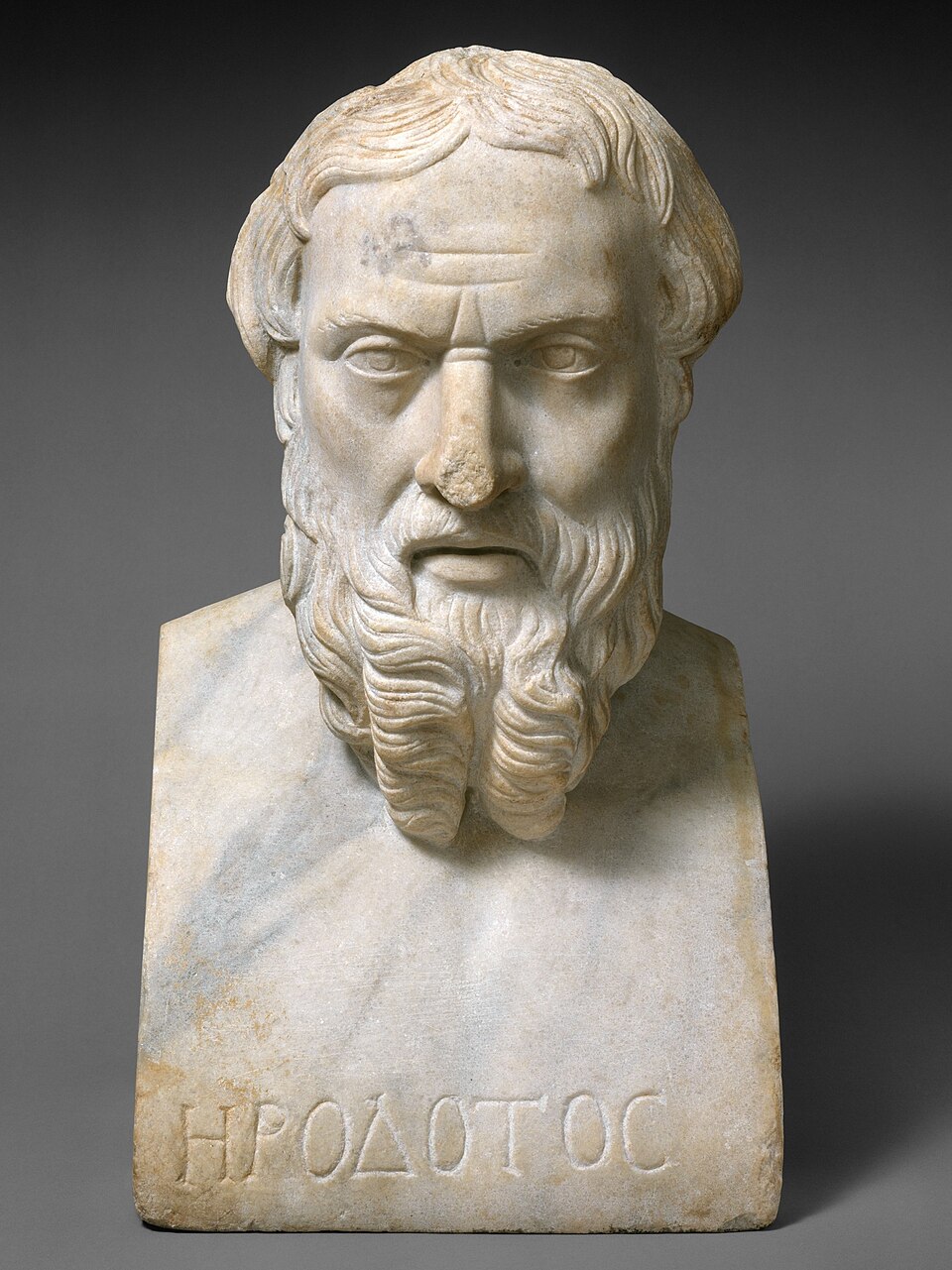
Histories
Ἱστορίαι (Historíai)
The founding classic of history-writing: Herodotus investigates how the Greeks and Persians collided—and turns it into a deep study of power, pride, culture, and human behavior.
Summary
Herodotus calls his book an inquiry: an attempt to preserve memory and explain causes. On the surface, the Histories tells the story of the clash between Greece and Persia—the long chain of events that ends in the great invasions of Greece and the famous battles that followed. But the deeper ambition is larger: why do empires rise, and why do they overreach?
Herodotus begins far from the battlefield. He traces a world of shifting power—kings, alliances, coups, marriages, betrayals—and shows how conflicts rarely have a single cause. Pride, fear, revenge, misunderstandings, and opportunism pile up until war becomes “inevitable.” He also refuses to write like a propagandist. He records competing versions of events, admits uncertainty, and often tells you when he is relying on hearsay.
As Persia expands, the Histories becomes a study of empire. Herodotus portrays Persian power as vast and sophisticated—administration, roads, tribute, and the ability to mobilize enormous forces. Yet he also shows the imperial weakness: distance, complexity, and the temptation of absolute confidence. The farther power extends, the more it depends on imperfect information, unreliable local actors, and a ruler’s belief that the world must submit.
One of the book’s most distinctive features is its “side journeys.” Herodotus pauses the main narrative to describe Egypt, Scythia, Lydia, Babylon, and countless customs and legends. These episodes aren’t filler. They teach a core lesson: political conflict is also a clash of cultures, values, and ways of seeing the world. Herodotus tries to understand people on their own terms, even when he disagrees or doubts.
When the Persian invasions arrive, Herodotus delivers some of the most famous scenes in ancient literature: speeches before battle, hard strategic choices, desperate alliances, and the thin line between courage and catastrophe. But even here, the emphasis stays moral and psychological. Leaders fall because they confuse power with invincibility. Cities survive because they coordinate, sacrifice, and choose discipline over panic.
Read as a whole, the Histories is not just “what happened.” It’s a pattern-book of political life: how pride invites disaster, how rumor becomes policy, how fear spreads faster than truth, and how human beings keep repeating the same mistakes—only with different uniforms.
Key ideas
Notable quotes
- ““This is the showing forth of the inquiry of Herodotus of Halicarnassus…””
- ““Custom is king.””
- ““In peace, sons bury their fathers; in war, fathers bury their sons.””
- ““Great deeds are usually wrought at great risks.””
- ““It is the common lot of mankind to err when they think they are most wise.””
Why it matters today
*Histories* still matters because it teaches political realism without cynicism. It explains how power fails: overconfidence, misinformation, bad incentives, and leaders trapped by pride. It also teaches cross-cultural seriousness: you can’t understand conflict by demonizing the other side; you have to understand what they believe, fear, and honor. In a world of propaganda, outrage, and imperial ambitions (old and new), Herodotus remains a master of the simplest discipline: **ask what happened, ask why, compare accounts, and watch how human motives turn into history**.
Recommended for
- Readers who want the first great work of Western history
- Anyone interested in empire, propaganda, and political overreach
- Students of strategy, leadership, and decision-making under uncertainty
- Readers who enjoy vivid stories grounded in real events
- People who want a cross-cultural view of the ancient world (Greeks, Persians, Egyptians, Scythians, and more)