
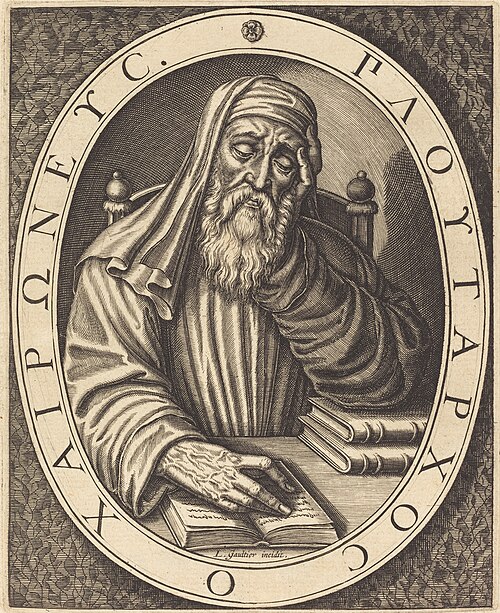
Moralia
Ἠθικά (Ēthiká) — traditionally collected as “Moralia”
A vast treasury of short essays and dialogues on how to live: Plutarch teaches virtue through practical counsel—education, self-mastery, friendship, leadership, and the struggle against superstition.
Summary
Plutarch’s Moralia is not one book in the modern sense. It is a library: dozens of essays, dialogues, and short treatises written across a lifetime, later gathered under a single title. If you want philosophy that lives close to ordinary life—how to handle anger, raise children, choose friends, speak well, lead responsibly, face fear, and resist superstition—this is one of the richest sources the ancient world left behind.
What makes Moralia distinctive is its tone: it is moral philosophy as guidance, not as abstract system-building. Plutarch is not trying to win metaphysical battles. He is trying to help you become a certain kind of person—steady, rational, dignified, useful to others. He assumes that virtue is real and that character can be trained, but he also assumes that people fail in predictable ways: vanity, envy, quick temper, laziness, obsession with reputation, and the weakness to believe comforting illusions.
The essays move between the personal and the civic. Plutarch can be intimate—advising how to listen, how to learn, how to speak without performing, how to hold your tongue when ego wants to “win.” But he can also be political: warning that cities rot when citizens chase private advantage, when education becomes shallow, when leaders treat power as a prize instead of a duty. He repeatedly returns to a classical idea: a society becomes what it rewards, and a person becomes what he repeatedly practices.
One of the most modern themes is Plutarch’s fight against irrationality. He distinguishes piety from superstition and treats superstition as a kind of mental slavery: fear dressed up as religion. True reverence, he suggests, should strengthen the mind, not paralyze it.
Because it is a collection, Moralia is best approached like a daily regimen: choose an essay, read slowly, and apply one lesson. Over time, the effect is cumulative. Plutarch doesn’t just give “ideas.” He gives the reader a moral mirror: you see your own excuses, habits, and weaknesses—and you are invited to outgrow them.
Key ideas
Notable quotes
- ““The mind is not a vessel to be filled but a fire to be kindled.””
- ““Character is fate.””
- ““An imbalance between rich and poor is the oldest and most fatal ailment of all republics.””
- ““Know how to listen, and you will profit even from those who talk badly.””
- ““To find fault is easy; to do better may be difficult.””
Why it matters today
*Moralia* matters because it offers something modern life rarely provides: moral training without performance. It’s not ideology, not outrage, not therapy-speak—just clear-eyed counsel about how people go wrong and how they can improve. Plutarch teaches restraint in speech, seriousness about friendship, discipline in emotion, and clarity in belief. In a world that rewards noise, speed, and identity, *Moralia* rewards the opposite: steadiness, depth, and the quiet construction of a trustworthy character.
Recommended for
- Readers who want ancient wisdom in short, standalone essays
- Anyone building character: self-control, patience, courage, fairness
- Leaders and professionals who need practical ethics, not theory only
- Students of Greek and Roman moral thought beyond the big “systems”
- People who enjoy reflective reading: one essay at a time